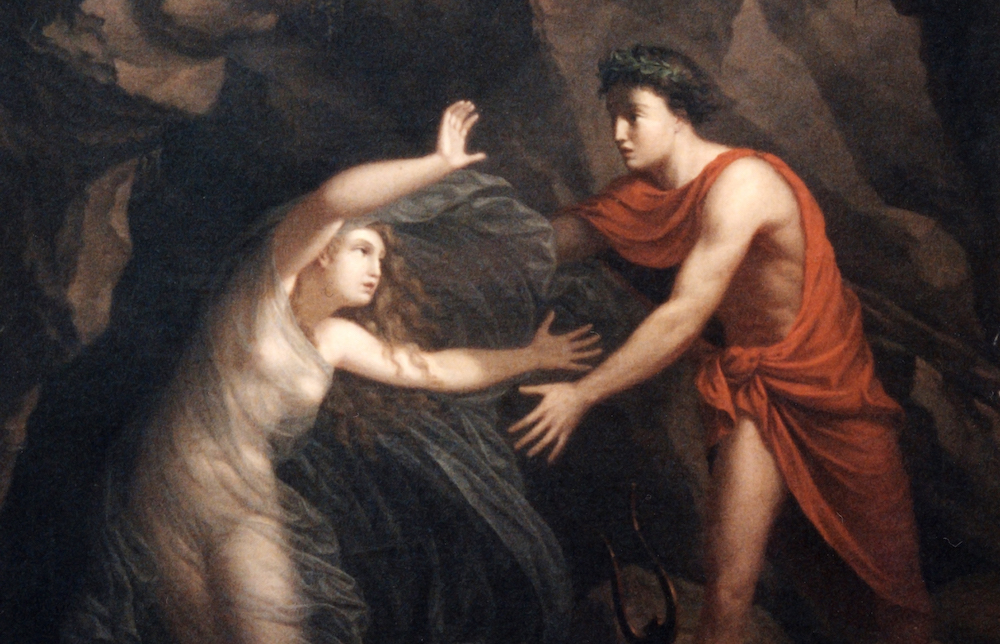
Christian Gottlieb Kratzenstein, Orpheus and Eurydice, 1806.
My mother often told me how much I’d looked forward to my first day of school. Although I find the thought extraordinary—I loathed school—it’s plausible. I was an exuberant boy. The deceptively effervescent nursery, which no longer exists, was located in an old house on Nepean Sea Road in Bombay. My mother dropped me there but lingered, to look out for me (she was very protective) but also to spectate. From afar, she watched me push a boy—a gesture of friendliness, she’d later insist. At this, the teacher apparently smacked me. I took great umbrage and began to cry. My mother swooped down and plucked me from the crowd of children. She believed the teacher had punished me because the boy I’d pushed was European. I went home but did not stop crying. In the evening, I got a fever. I didn’t want to go to school the next day. The honeymoon period was over.
After that first experience, my parents struggled to put me into a series of kindergartens. I finally found myself attending a school called Sunny Side, a seven-minute walk from the flat we then lived in on Malabar Hill. Once, when my father dropped me off on the way to the office, I refused to get out of the car. I remember him opening the door on the left, then the right, as I moved sideways each time to the opposite direction.
Occasionally, I resigned myself to mornings in Sunny Side School. My favored spot was the doorway, where I said goodbye to my mother, watched her walk home, studied her as she turned to wave, and instructed her, with a gesture of my hand, to come back soon.
The doorway marked a line separating one phase of experience from another. From the outside, it was to be resisted with as much ferocity as possible. Once one had been coerced beyond the threshold, it was the place to look out from.
Between the ages of four and six, the journey to school was a short walk, but no less stressful for that. Later, it was a drive on the road going into Churchgate toward Flora Fountain; my eye could follow this arc from the balcony of the twelfth-story flat I lived in. On Sunday evenings, I memorized that route with foreboding.
The fear of school has never left me. It has simply transmuted into other forms of fear, including travel. Today to travel is to rehearse that daily journey. I watch inertly, relive the momentum, as the car moves forward to the airport. Travel means leaving family behind. It began when I was an undergraduate in England in 1983. International flights departed Bombay at 3 A.M., an hour of aftermath, vacated of humanity. The roads were ruled by machines—traffic lights flashing orange. The airport would mill with purgatorial activity. I would drag my suitcase, check in, and approach immigration. A moment would come when I would look back at my parents. As an adult, I could make a choice. I could abort my journey. But as at the doorway of Sunny Side, there was no going back.
There is no going back once you’ve crossed a particular, often intangible, barrier at the airport. I’ve looked at my parents (both are dead now); I’ve peered at my wife and daughter (the latter herself now lives in a different county). We’ve waved. The airport is not a house. It is a place of divergence where the unhoused gather. After waving, I move on. The last glimpse is like death. Then something like a new life begins.
It’s not school I hated, I now realize. It’s the abeyance and unbelonging that leaving brings. You’re alienated from your familiar surroundings—the furniture, the people you love. Belatedly, you see how the ordinary, the unconscious stuff of existence, is a form of enchantment that’s had you in its spell; departing home, you become disenchanted. It’s an experience of posthumousness, which plausibly begins for humans well before they die. You’re here but already not here. You’re slowly becoming invisible. When you’re going to travel abroad, your sense of “being home,” of corporeality, fades as you approach the barrier at immigration. Once you pass the doorway, you’re still mourning, but you begin slowly reconstituting yourself. You become a physical entity again. As you cross time zones, you eat meals at unexpected hours, with a strange frequency. This is part of a rebirth.
Is it because of both the triviality and significance of the moment of the doorway that we have so many accounts, in mythology and literature from various parts of the world, of the futility of looking back? Did Rilke, when composing “Orpheus. Eurydice. Hermes,” base his delineation of Eurydice’s journey on the day-to-day dislocations he himself undertook? Or did he feel that these recurrent undertakings that involve leaving home mimic what it means to die, to leave your old self behind, and take on, inevitably, a new one? In the myth, Orpheus has descended to a different time zone, Hades, and is attempting to bring his wife, Eurydice, back to earth, to the enchantment of the familiar. He has been granted this power by the gods, to enter Hades untouched and to lead Eurydice out, on the condition that he not look back at her as she follows. Not being able to hear her footsteps at one point (she is still a shade), he turns back and loses her eternally. This compulsion defines behaviors across cultures. Colloquial Bengali has a lovely term for it, pichhu taan: the pull of what you’ve left behind. The gods won’t let Orpheus access Hades twice.
In Rilke’s poem, Eurydice has already internalized Hades’s time zone. Her body is adopting a new clock. Rilke sees her not so much as a shade but as a person who is taking on a new material being to which her husband is more and more irrelevant:
She was deep within herself, like a woman heavy
with child, and did not see the man in front
or the path ascending steeply into life.
Deep within herself. Being dead
filled her beyond fulfilment. Like a fruit
suffused with its own mystery and sweetness,
she was filled with her vast death, which was so new,
she could not understand that it had happened.She had come into a new virginity
and was untouchable … (Trans. Stephen Mitchell)
This could be why I resist the doorway so fiercely. Not just because of the pain of being uprooted but because of the possibility of being rooted anew, of forgetting what, and whom, I once loved.
Amit Chaudhuri is a novelist, essayist, poet, and musician. His most recent novel is Friend of My Youth.
from The Paris Review http://ift.tt/2D1Ecvp
Comments
Post a Comment