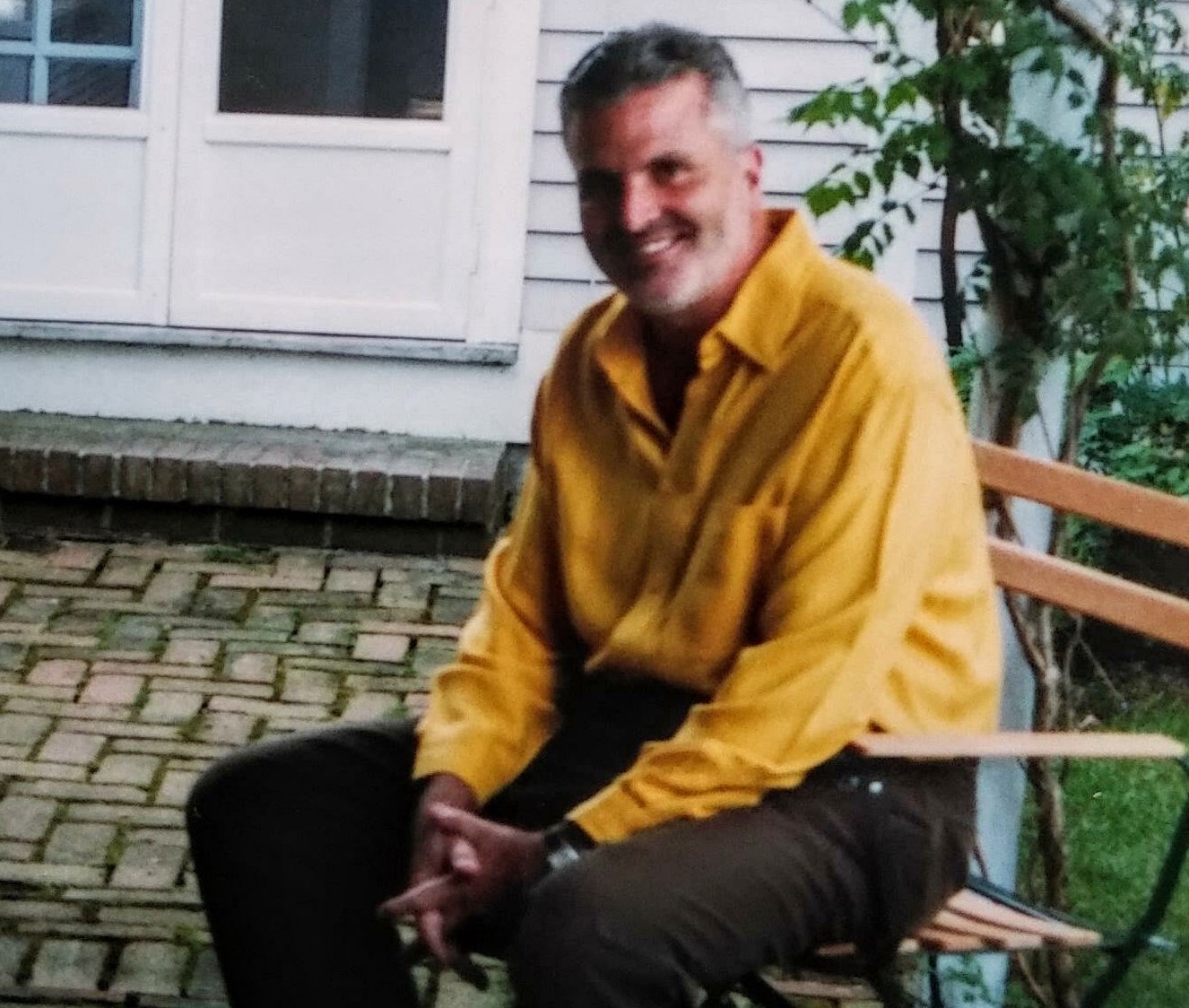
J. D. McClatchy (Photo: Henri Cole)
We must have met in 1980, when I was twenty-four. I was a graduate student in New York City. Sandy was teaching in New Haven. This was before email, Facebook, and Twitter. Poets wrote letters and talked on the telephone (land lines!). Sandy had just published his first collection of poems Scenes from Another Life, and he and his partner had invited me to dinner in New Haven. They were being kind to a young fan who’d only published one poem. I was not really a poet yet or out of the closet. There was also a young Mexican poet at the table, who would later drown while swimming in the Pacific. After a delicious dinner, cooked by Sandy, a joint was passed around. There was not any talk of AIDS yet, as there would soon be, like a hatchet falling through the room. But a profound sense of freedom. Openness. New friendship. “I cannot remember a moment of my life when I didn’t know I was gay,” Sandy said. For him, being gay was simply a fact, like being a poet.
This was the era of new formalism, and Sandy was “a painstaking and brilliantly adventurous craftsman,” to quote Stephen Yenser, “the epitome of the writer with savoir faire” and “outrageously candid.” His poems were eloquent, yet rueful, a combination I loved. He was not afraid of being difficult. “The poem must resist the intelligence/ Almost successfully,” Wallace Stevens wrote in “Man Carrying Thing.” In my own poems, it was the “raw power” he praised. Sandy wasn’t prim. I think he was the first real man-of-letters I knew. A gay man-of-letters—what a fine thing to be, I thought. Could I be that? He was always up to his ears in teaching and projects, running between this task and another: “I still feel like the baby Achilles, being dipped by my heel into the waters of busywork,” he wrote.
The years flew past. His poems were changing and arrived at a place of savage emotional intensity. He was like a brother in poetry. At a café in Stonington, Connecticut, we were sitting on a deck under an awning having lunch. This was to be my last visit with James Merrill, our favorite living poet, who seemed suddenly older and would die soon. They were eager to ride in my robin’s egg blue ’69 Ford Fairlane, and eager to have their neighbors see them dropped off in my “hot rod.” Then we were climbing the three flights to Merrill’s apartment, the door to which was left wide open. The rooms were in disarray, with books and correspondence lying about. Sandy was showing me the big pile of dirty dishes in Merrill’s kitchen sink. I told him that he and Jimmy would make a perfect couple, because his house was so orderly and immaculate, and this made them laugh. Then Sandy was showing me the garden of the writer Eleanor Perényi, where my teacher David Kalstone’s ashes were long before scattered under an apple tree. What large, venerable trees there were.
Then more years flew past, and Sandy was visiting hectic Kyoto, where I was living. He wanted to see the Saihō-ji Zen Buddhist Temple, famous for its moss garden, in the western hills. There was a pond shaped like the Chinese character for “heart.” My favorite part of the historic temple was not the moss garden but sitting in a tatami mat room and doing a brief lesson, or religious rite, called shakyo. We traced the sutra with a brush dipped in ink and then wrote out our greatest wish, which we left at the altar for fulfillment, under a gold chandelier, before the Buddha. This was meant to be therapeutic, but Sandy was not religious. He couldn’t understand how anyone gay would choose to be Catholic.
Again, the years flew past. Then, I was almost sixty. Sandy wrote to say I must apply for a job in California. I applied. The chairman of the Department of Literature was Seth Lobis, who was once Sandy’s student. One degree of separation. Despite the miles between us and the years without any word from me, Sandy did not forget me. He had free-lanced, too, and known the toll of uncertainty upon the poet. Seth met Sandy when he was eighteen and a freshman at Yale. He worked for him at The Yale Review. “I learned from Sandy that taste was about openness and generosity as much as about selection and exclusion…Just when I expected him to be a neoclassicist, he was a romantic or a fauve or a futurist. His aesthetic admiration and pleasure seemed unpredictable, incalculable, far-reaching, but somehow never far off. His discrimination never discriminated,” he remembers.
I think of my poetry family as a chorus at the opera, but without Sandy’s voice we are smaller now. Here are some other voices singing a lamentation of praise:
Harold Bloom—“He was invariably kind, lucid, loving, exuberant, and wise. I grieve for one more authentic poet gone from us.”
Joyce Carol Oates—“Magnanimous, warm, funny—sympathetic and welcoming—brimming with enthusiasms—there is no one remotely like him.”
Lorrie Moore—“He had such a beautiful voice—both spoken and written…Every nice surprise that ever came my way he seemed to be responsible for, like a magician behind a curtain.”
Helen Vendler—“I admire his courage in creating poetry from his terminal cancer. Testimony is one of the great blessings to poetry readers.”
Louise Glück—“I valued him as a colleague. And aspired to the pith and eloquence and revelatory insight of his criticism.”
Edmund White—“Erudite, sexy, magisterial, he resembled an older generation of genius poets.”
Karl Kirchwey—“At a crucial point in my development as a poet, he provided blunt and necessary criticism.”
Stephen Yenser—“Innately charming and fluently witty… An exemplary friend—current, steadfast, provident, generous—he was a model of courage in tight situations.”
Rosanna Warren—“He was supremely generous to other writers and to the art of poetry, editing volumes, creating a series of poetry recordings, and welcoming several generations of writers in the pages of The Yale Review.”
Frank Bidart—“It was thrilling to watch his work grow in unpredictable, ferocious ways. His death robs us all.”
There is one more light out on the mountain now.
Henri Cole is the author, most recently, of Orphic Paris. You can read our Art of Poetry interview with him here.
from The Paris Review https://ift.tt/2HpXf8R
Comments
Post a Comment