I was in college when Trayvon Martin was murdered. I created an anonymous pamphlet, an artistic response to the atrocity. His killing deserved our outrage. Late one night, I scattered five hundred copies of the pamphlet around campus. I went to bed expecting unrest, a revival, a conversation, anything. When I got up later that day, nothing happened.
That summer, I was at a barbecue in Riverside Park when Trayvon’s murderer was acquitted. I remember getting the notification on my phone. I felt exposed, fragile. I had been partying just a minute before.
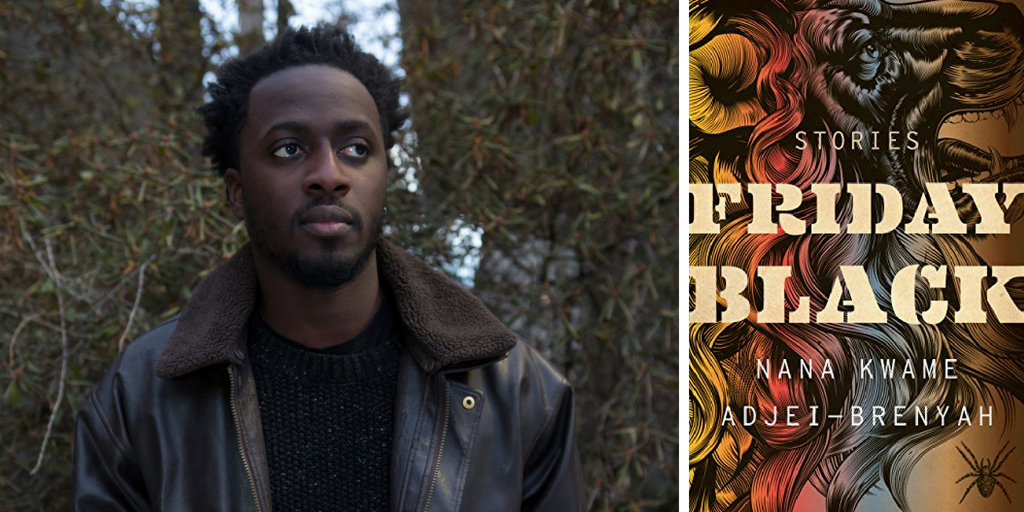
Years later, writing “The Finkelstein 5,” the story that now opens my first book, Friday Black, I tried to translate the ways in which the justice system is often a cruel joke for black Americans. I wanted to express the feeling of always being perceived as a threat by so many. The completion of this story was the closest I’ve ever come to a breakthrough. It was the second time I felt that I wanted people to read what I’d written, even if my name was not attached.
I’m interested in the ways we dehumanize each other. I’m interested in our capacity for good, despite the insidious hatred and fear all around us. All the stories in Friday Black, including “The Finkelstein 5,” were tough to write. And yet, in that space of difficulty and fear, I found necessity and purpose.
In every interview I’ve done so far to promote my book, I have been asked some version of, Why do you write political stories? I’ve learned a few things about what it means for me to engage with the political through fiction, and also about what that question means to people. I personally believe that as a writer, you participate in society; no art (or person) emerges from a vacuum. I do not mean that all art has a political platform, but rather that artists have an identity that intersects with society in various ways. To create art has political implications. To be black and exist in a space has implications. The same is true of being white, but because of the privilege inherent in whiteness, those implications often aren’t examined in the same way.
I think what people mean when they talk about my work as political is that my stories often engage with issues that are considered big. Racism and rampant consumerism are examined in my fiction because they are things I examine in my life. It is a precarious thing to use fiction to explore and illuminate high-stakes issues. There’s always the chance you will be misinterpreted. In one of my stories, a character is thinking about his part in a terminated pregnancy. And yet, I can’t think of many things more troubling than the possibility that a reader will believe that I, in my personal life or on the page, am anything other than vehemently pro-choice. In the same way, I fear the possibility of recreating in my life the same racially charged violence I hope to dismantle on the page. Roger Reeves, in his talk “The Work of Art in the Age of Ferguson, Baltimore, and Charleston,” explores this possibility. I have my students watch it in almost every creative class I teach.
Because I write fiction, not pamphlets, my work is to tell stories as best I can and to trust my instincts. I have to hope that it’s clear that I’m saying things at a slant. I’m not saying, Isn’t capitalism, despite its brutality, great? Instead, I’m saying, Hey, maybe it’s unacceptable that humans are trampling humans for big screens. I try my best to follow the examples of writers like Toni Morrison, Alice Walker, and George Saunders, who write from their hearts and are still able to engage directly with the problems of the world.
I write political stories because that’s what comes out when I write. Because for me, writing is a mediation, and a cultivation of power. If I am to have any power in this world, I hope it can be used to help my sister or my brother or myself to live less encumbered by the overwhelming weight of oppression. And yet, I sometimes find myself frustrated by the labels associated with the politics in my work. I was asked in an interview what word I am most tired of hearing in regards to my fiction and what came to me immediately was timely. I see it everywhere. As if the problems in my stories are new—hey guys, come check out this fun new timely racism! How convenient to have the privilege to tune in or out of whatever issues popular culture has suddenly deemed relevant enough for everyone to care about.
And yet, I understand and accept that often a book, such as the incredible Red Clocks by Leni Zumas, is indeed political and timely. I know that I, and all men, can take this current political moment—when the American president is an unrepentant misogynist and sexual predator, women’s bodies are under constant threat, and the cultural plague of sexual violence is being addressed in a myriad of ways—and use the instance of cultural focus as a way to listen and improve ourselves. I just fear what happens when popular culture gets bored and decides it’s time to move on to something else.
I do write stories that are political, but I am decidedly out of the pamphlet game. To get to a story like “The Finkelstein 5,” I had to first have a professor, one Arthur Flowers, offer me and my entire class a prompt: Write a story to save the world. To that, I wrote a two-page story about my mother, basically saying, I love you mom. To show that each of us is, at our specific intersection of identity and society, a human with a heart can be just the kind of salvation we need. It might be that simply existing, unapologetically and fully, is the political work we are meant to do.
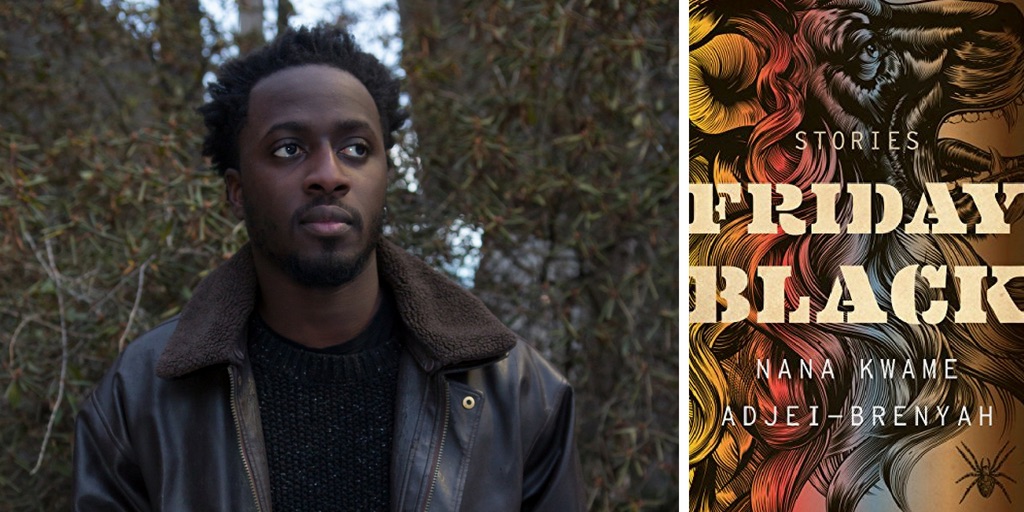
Nana Kwame Adjei-Brenyah is the author of Friday Black, his first book. He has an M.F.A. from Syracuse University and his work has appeared or is forthcoming in numerous publications, including Esquire, Guernica, Printer’s Row, and The Breakwater Review, where ZZ Packer awarded him the Breakwater Review Fiction Prize in 2017. He was selected by Colson Whitehead for the National Book Foundation’s “5 Under 35.”
from The Paris Review https://ift.tt/2RcjAIm
Comments
Post a Comment