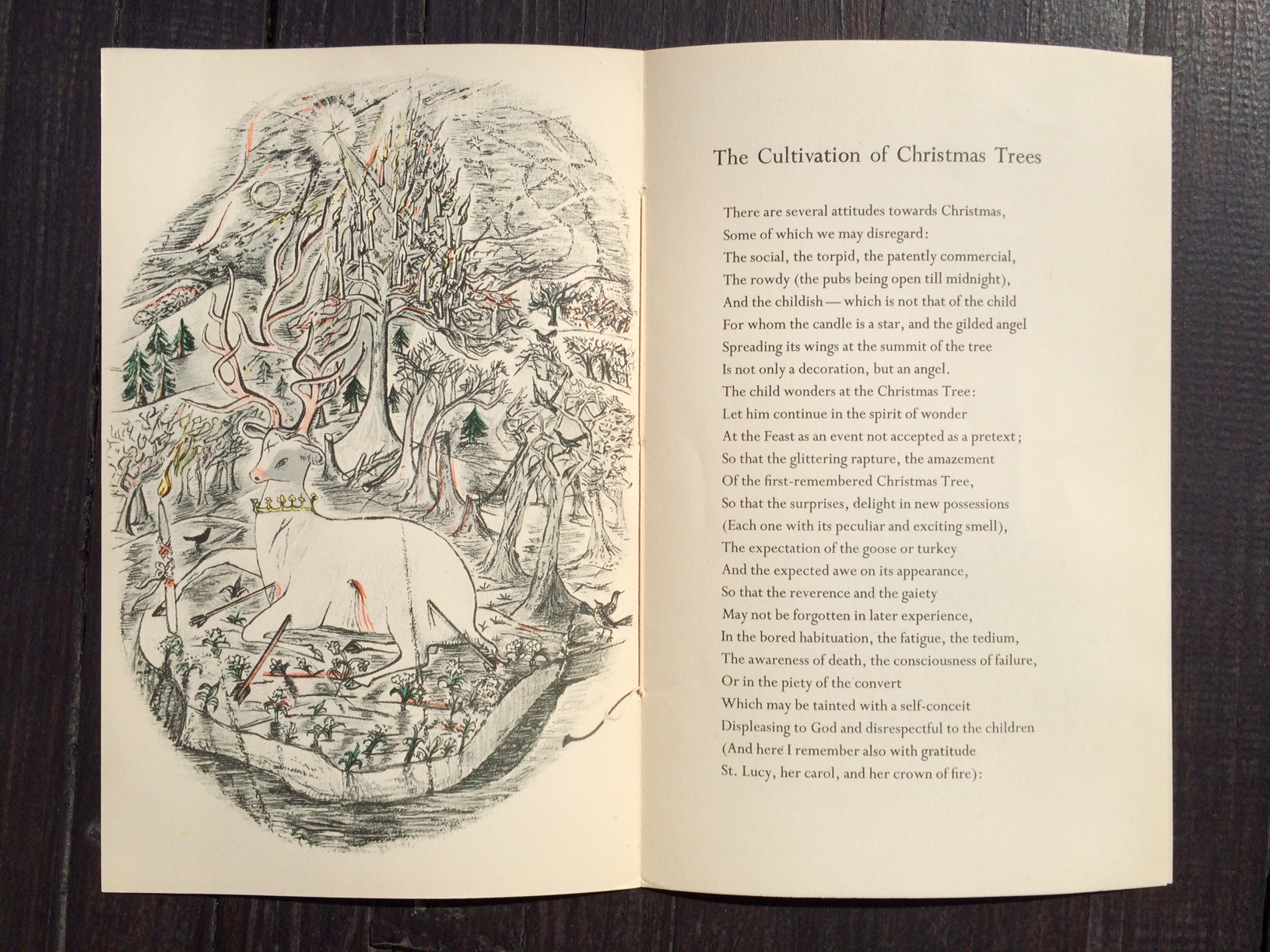
T. S. Eliot’s “The Cultivation of Christmas Trees”
I’ve spent a lot of time guddling around the Daily archive of late. There are many joys attendant to this, not least the expansion of that tragic category, Literature I Should Already Be Familiar With. This rapid multiplying of “known unknowns” is the reason I’m reading a Christmas poem, T. S. Eliot’s “The Cultivation of Christmas Trees,” in March. Casey N. Cep’s Daily article does a perfect job of describing the history behind Faber’s Ariel Poems series, to which Eliot’s piece belongs, so I’ll direct you there instead of rehearsing it here. Perhaps after reading, you’ll do as I did and buy yourself a springtime Christmas present: one of the slim original pamphlets from 1954. They’re beautiful. So beautiful, in fact, that I can’t really justify holding on to it—I know my Christmas-loving mother would appreciate it far more than I do. Reluctantly, next December, I’ll give it away. Thank heavens it’s not yet April. —Robin Jones
This week rekindled my perennial fascination with scams, but in the midst of all the unsurprising college-admissions revelations, my favorite con story went overlooked: Michael Finkel’s recent profile of Stéphane Breitwieser for GQ, “The Secrets of the World’s Greatest Art Thief.” There’s a particular intrigue that comes with words like heist, and career art criminals are afforded a certain cultural cachet. Infiltrating a notoriously exclusive industry mostly by the good grace of grit and wiles conjures images somewhere between the highbrow glamour of James Bond, and Rihanna’s casual, cargo-sporting genius in Ocean’s 8. It’s true crime but intellectual, and the individuals who forge, steal, and/or black-market valuable artworks are a particular breed of curator. Mastermind is a word that comes up frequently, but passion less so. The Breitweiser profile offers a nuanced image of the art thief, describing a man who is equally the arrogant, plotting magician as he is passionately enthralled, obsessed even, with art. Beginning in his early twenties, Breitweiser amassed hundreds of stolen objects—from antique pistols and goblets to Renaissance paintings—worth millions of dollars, all hidden in a private collection in his bedroom. The methods employed in these small-scale heists are notably audacious: tucking carvings and panels under his coat, Swiss Army knifing display cases open, and rolling antique urns down the road, all in broad daylight, assisted by Breitweiser’s girlfriend-turned-lookout. With a final Icarian turn of events, this story has all the pieces of a tragedy: hubris, a journey through countless countries, and an inevitable downfall that leaves our hero ostracized from all he loves. Finkel describes a fascination with beauty that grows into a compulsive desire to own; it’s one of the best stories I read this month and the perfect emotional charge to liven up my third coffee of the day. —Nikki Shaner-Bradford

Heike Geissler.
I first read Seasonal Associate, the German writer Heike Geissler’s 2014 novel about working in an Amazon distribution center, on Christmas Day last year. It just felt right to remind myself of the actual human labor that goes into the frenzy of gift giving, the forced banalities of holiday cheer. The novel, newly translated into English by Katy Derbyshire and published by Semiotext(e) in December, is based on Geissler’s own experiences working as a seasonal associate in the Leipzig Amazon distribution center. This week marks my second time reading the book, after seeing Geissler give a reading at the Goethe-Institut New York on Tuesday. The talk that followed clarified a few things for me: the way the narrator passes between the first and the second person, for instance, apparently stems from Geissler recording herself reading an earlier draft aloud and uploading it to her website. In the novel, it’s a clever formal trick that implicates all of us—reader, writer, worker—in the self-doubt and boredom of the job, while also dissolving the boundaries between art and real life. References to other artists, in fact, abound: near the first half, there’s an extended meditation on Tracey Emin’s My Bed, and quotes from Elfriede Jelinek, Rainald Goetz, Jules Laforgue, and more make appearances. But Geissler is never didactic. By the end, the novel achieves a successful fusion of politics and art, looking askance at ideology in order to create something more complicated, unrulier, and truer to the inconsistencies of everyday life. —Rhian Sasseen
The year before her death, Mirtha Dermisache wrote, “I must admit that all my works create some tension between the communication formats offering a stable framework and the act of writing, which provides the stable dimension.” Renee Gladman—whose ink drawings are in many ways the progeny of Dermisache’s line sketches, both of which mine the intersection of written language and meaning—is a master of that tension. Morelia, a sketchbook in its own right, is a slender piece of prose out this week from Solid Objects. The specific tension therein is between the waking and dreaming states, between the domestic spaces of the home, and the world that exists outside of them, all happening at the point where language and imagination fail to connect. Even in the space of forty-three pages, Gladman is a master of interior civil planning, and while this is perhaps not the place to start with Gladman’s work (and was in fact written ten years ago, before her more fully formed Ravicka books entered the world), it is an exciting piece of her oeuvre that those already acquainted will devour in an afternoon. —Lauren Kane
Once upon a time, witches were bad. Now witches are good and read your tarot and go to your yoga class, and this is a better arrangement. At first, I understood Patricia Lockwood to be a witch of the former type. Now I know she’s one of the latter. Besides being a witch, Patricia Lockwood is a poet on the internet, which I mean both literally and also figuratively. A light-blue bird is her familiar, and it sings in a language that she understands. The London Review of Books asked her to translate for their audience; in the February 21 issue, they published a lecture she gave at the British Library on “the portal.” She asks, “What are you swimming in, that you can’t describe—won’t describe, because it’s too ordinary?” In order to describe her relationship to the internet, she found it easier to write about herself in the third person, and the result is a crate of the rarest fruit the digisphere has to offer—or, in her parlance, “arms full of the sapphires of the instant.” The internet is a “single eye that scan[s] a single piece of writing … Sometimes the pieces addressed the highest topics: war, poverty, epidemics. At other times they were about going to a deli with a poor friend who was intimidated by the fancy ham.” In Lockwood’s hands, the thread of the internet becomes the Thread of God from C. K. Chesterton’s The Innocence of Father Brown: a lead that lets the faithless go only far enough to feel they are free before they are called back with a “twitch.” But that’s context, and as Lockwood notes, the portal is defined by “context collapse! That sounded pretty bad, didn’t it? And also like the thing that was happening to honeybees?” The essay is hilarious and terrifying and much more truth telling than soothsaying, but Lockwood is a sorceress nonetheless. So tune into her channel, take her cure, show her your tea leaves, or perish, because we’re all on the internet now, but only some can hear it. —Julia Berick

Patricia Lockwood. Photo: Grep Hoax. © Grep Hoax.
from The Paris Review https://ift.tt/2Y0lHTR
Comments
Post a Comment