It’s there in the early books we read—the ideal of friendship, its glimmer.
 “But his favourite person of all was Miss Nancy Alison Delacourt Cooper because she had four names just as he did,” writes Mem Fox in Wilfrid Gordon McDonald Partridge. “He called her Miss Nancy and told her all his secrets.”
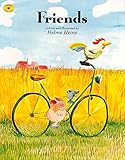 “But that night they dreamed about each other, the way true friends do,” assures Helme Heine in Friends.
“You have been my friend,” a fading spider tells a mourning pig in E.B. White’s Charlotte’s Web. “That is itself a tremendous thing.”
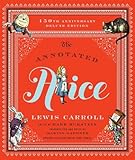 Red and Fred in P.D. Eastman’s Big Dog…Little Dog. Mary and Colin and Dickon in Frances Hodgson Burnett’s The Secret Garden. The Walrus and the Carpenter in Lewis Carroll’s Alice in Wonderland. Mary and Celestine in Louise Erdrich’s The Beet Queen. We grow into our friendships as we grow into our books—the ideals crack, what is lost can be more powerful than what is gained, and what is gained is never absolute. This is friendship that we’re speaking of: gesture, theater, refracting lens, perhaps only temporary reprieve, provocatively more complicated as the years unfold.
The Venn and fray of adult friendship are the propulsive stuff of recent novels by Sally Rooney, Rebecca Makkai, Sigrid Nunez, and Jessica Francis Kane. The books arrive at an anxious time, when social media “likes” appear to absolve us of the need to actually engage, GoFundMe campaigns stand in for hugs or cheers, and political maneuvers aim their ammunition toward the shatter of communities. We align, but do we step in? We care, but do we call? We know that true friends should fall to sleep dreaming of each other, but instead we groom our solitary nightmares. In all of this, the questions remain: What is a friend? What do friends do? What does one friend owe to another, and is friendship love a separate kind of love or something else altogether?
Is friendship a word without borders?
Should there be borders?
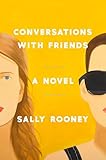 In Rooney’s Conversations with Friends, college students Frances and Bobbi were lovers before the story begins, but when we meet them, they’re “just friends”—two girls becoming increasingly entangled with an older married couple. It’s a dangerous business, a lark with consequences, and as one betrayal follows another, the “just friends” business grows increasingly strained and strange.
We read the novel to find out what the girls expect from one another and what secrets might be ethically protected. We read because Rooney is forcing us to decide whether, within the fluid realm of contemporary friendship, any semblance of propriety must be preserved. When a relationship becomes self-consciously ironic and blurred, is that friendship or is it love and does that matter?
Marianne saw us holding hands in college one day and said: You’re back together! We shrugged. It was a relationship, and also not a relationship. Each of our gestures felt spontaneous, and if from the outside we resembled a couple, that was an interesting coincidence for us. We developed a joke about it, which was meaningless to everyone including ourselves. What is a friend? We would say humorously. What is a conversation?
Rooney is an outstanding chronicler of the fluidity of friendship in a “with benefits” world. It’s a modern arrangement that may well trigger old-fashioned devastation. “Well she’s not my girlfriend as such,” Frances says. “We’re sleeping together but I think that’s a way of testing the limits of best friendship.”
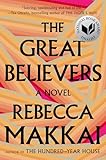 For Makkai in The Great Believers, the death of Fiona’s gay brother in mid-1980s Chicago creates an inheritance—a community of friends—that will succor and haunt her for the rest of her life. The bonds run deep. So does the heartbreak. Fiona’s friendship with gay men like Yale Tishman, for example, snaps her relationship with her husband and ultimately estranges her from her daughter. If friendship is Fiona’s talent, it is a freighted one, burdened by the temptations of possession.
Friendship, a benevolent word, is rife, for Makkai, with repercussions. It is also, as we learn from Yale himself, a concept steeped in melancholy. Yale has no lover toward the story’s end, but perhaps he is not lonely. Perhaps he has learned—not too late, but almost—that friendship, at its core, is elemental. Writes Makkai: “And was friendship that different in the end from love? You took the possibility of sex out of it, and it was all about the moment anyway. Being here, right now, in someone’s life. Making room for someone in yours.”
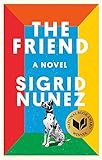 This thin line between love and friendship plays out brilliantly in Sigrid Nunez’s slender and affecting The Friend. The narrator is a writer and teacher of writing who speaks, throughout the book, to her dear friend, now dead of a suicide. These two were lovers but once. They were friends for nearly lifetime. The narrator won’t stop speaking to her lost friend, won’t stop imagining him with her, won’t stop remembering who he was and conjecturing whom he might have become. The narrator even agrees to her lost friend’s wish that she adopt his harlequin Great Dane, a majestically mourning beast who threatens to consume the narrator’s 500-square-foot apartment.
Is mourning for a friend the same as mourning for a lover? Does it matter? Will the dead friend always be more real than those who are still alive, still offering the narrator a chance to engage in a living conversation? “The dead dwell in the conditional tense of the unreal,” Nunez writes. “But there is also the extraordinary sense that you have become omniscient, that nothing we do or think or feel can be kept from you. The extraordinary sense that you are reading these words, that you know what they’ll say even before I write them.”
And that dead friend’s dog? It is, Nunez writes, “like having a part of you here.” But ultimately, Nunez suggests, surviving the loss of a friend is not much different from surviving the loss of a lover; it may even be, given the permutations of the condition, harder. “The dog has to forget you,” the narrator says, though she might as well be speaking of herself. “He has to forget you and fall in love with me. That’s what has to happen.”
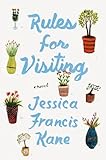 In Jessica Francis Kane’s forthcoming novel, Rules for Visiting, May Attaway lives a seemingly uncomplicated life with her elderly father in the house where she grew up. She’s a university gardener with pleasant-enough interactions, but when she reads about a young woman’s death and the deeply affecting mourning that emerges in its wake, she recognizes the vacancy that has crept into her life.
“You could be good at being a friend, and no sooner had I had the thought than I knew I was not,” writes Kane. “I had some friends, but did I have a community? No. Would a group of us someday rent a beach house together and have a weekend of frivolous yet somehow poignant fun? Never. Most of my friends do not know one another, and even if they did, I’m certain they would not consider me the center of anything.”
An unexpected gift of time sends Attaway on a journey to discover something about her capacity for friendship, which is to say her capacity for all that friendship demands of us: spontaneity, tolerance, humor, truth, the willingness to be our unguarded selves, and the strength (which is desire) to carry each other forward. Kane is a quietly humorous writer, a thoughtful purveyor of friendless tropes and quotes, social media fallacies, awkward inner thoughts. Her careful narrator is carefully concealing the reason friendship has been elusive in her life.
 Love and friendship are indivisible, Eudora Welty wrote in her introduction to The Norton Book of Friendship: “The solidest friendship is that of friends who love one another.” Still, the math is hard to figure—the calculations and permutations of friendship spill forward, always, in story. The new friendship novels challenge us to be the friends we could still be. The new friendship novels offer truth in consequences.
Image credit: Unsplash/Korney Violin.
The post Four New Friendship Novels and the Bonds That May Not Tie appeared first on The Millions.
from The Millions https://ift.tt/2K349Uk
Comments
Post a Comment