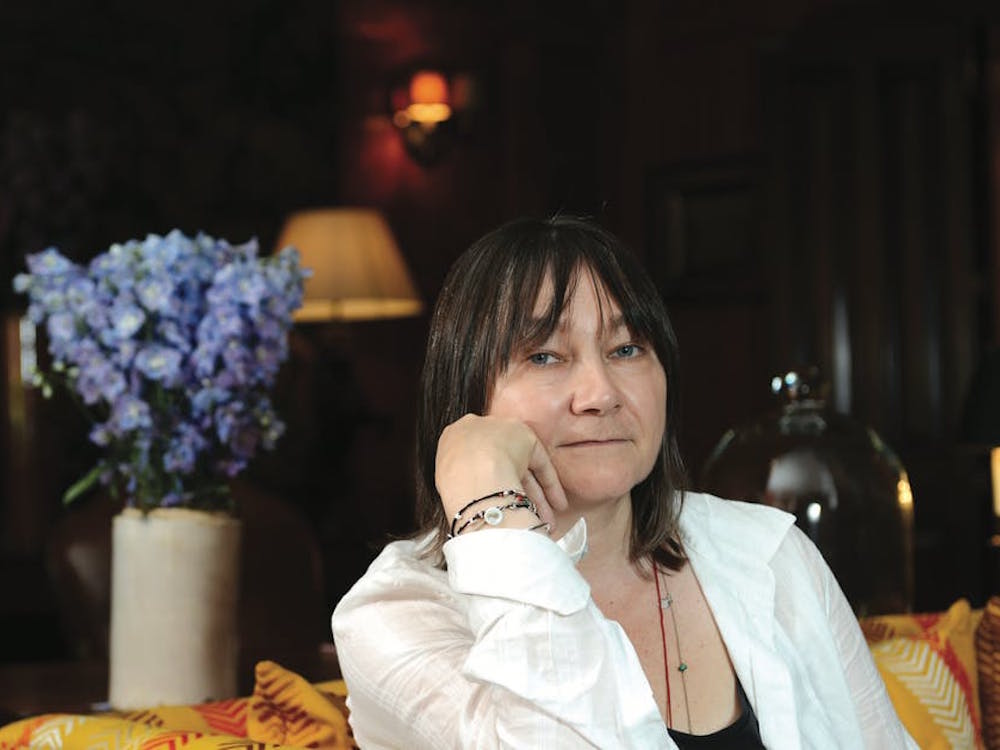
Ali Smith. Photo: Christian Sinibaldi. © Christian Sinibaldi.
Dear Mum, I know it’s not Mother’s Day in Scotland, but it is here in America, so: Happy Mother’s Day (Reprise)! The Queen has two birthdays—maybe you can have two Mother’s Days? Anyway, I’m only half way through Ali Smith’s Artful, but it’s already sad and clever and beautiful. The book is composed of four lectures on literature, tangled up with a narrative of mourning, and is gently self-aware in a way that isn’t annoying. You’d like it, I think. I’ve just ordered another copy online and had it posted to you. I’m sorry it won’t arrive in time for Sunday (I didn’t have any forewarning regarding this extra Mother’s Day). What else from New York? I just read Emmanuel Carrère’s My Life as a Russian Novel, and it was a splendid, if somewhat traumatic, experience. Carrère lays bare his faults in such a way as to make one feel very aware of one’s own. It, too, is sad and clever and beautiful, but even so, I can’t recommend it to you, owing to it being occasionally pornographic. If you want to read it, you’ll have to find it for yourself; I can’t be involved. Anyway, Happy Mother’s Day! Again! —Robin Jones
I have what might be called an anecdotal family (and they all read these staff picks—hello, everyone). We relate to each other through our own dialect of stories; when we get together, our conversations are mostly recitations of stories we’ve told and heard a thousand times already. Natalia Ginzburg coined a term for this: a “family lexicon,” which is also the title of one of her novels, an excellent gift for the maternal figures of any such family. I also recommend for anyone from a family of raconteurs Occasional Magic, the most recent anthology from the famed storytelling organization The Moth. This is not what I’m getting my mother (I can’t give that away here), but I sent her a copy earlier this year to rave reviews. I haven’t read it, but I’m sure she’ll want to tell me all about it. —Lauren Kane
This past Passover, my French mother insisted that we celebrate together. My family doesn’t always celebrate, but when we do, it is off-kilter and tongue-in-cheek—my dad reads from The Communist Manifesto instead of a Haggadah, while my mother, who became a Jew in a quick-conversion night class in the seventies to please her father-in-law, throws wine-drop plagues on her plate such as “climate change” and “social media.” This year, when we sat in the living room after dinner to read, my mother and I had both unknowingly brought the same book: Isabella Hammad’s The Parisian. Written with the perfect poise and lyricism of the greatest eighteenth-century literature, the novel follows Midhat Kamal, a romantic turn-of-the-century aesthete from the town of Nablus, in Ottoman Palestine. Hammad is a master of the small social detail: the way a sleeve might be rolled up just a bit too far or a man might run his tie between his fingers as he speaks or a woman might lift a single strand of hair from her forehead with one finger. Before the backdrop of perfectly observed conversational slights and lustful glances, the drama of the Middle East unfolds. My mother and I each retreated to our bedrooms that night, and I could hear her through the thin floorboards in the room above me, turning the pages. “Oh,” we said to each other the next morning, bags under our eyes from staying up too late. “It’s really good.” —Nadja Spiegelman
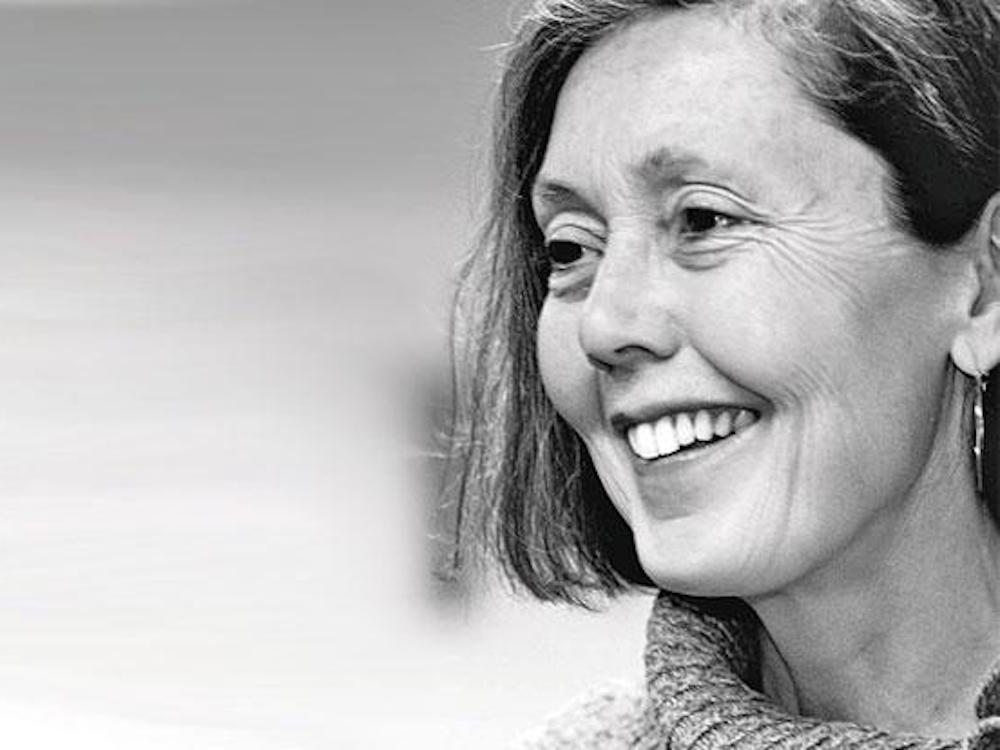
Anne Carson. Photo: Peter Smith. © Peter Smith.
Having reached a point where it feels like I am still growing up but am actually just growing older, one of the things I’ve found particularly disorienting is how the most fundamental relationship I have is changing. In many ways and at many times I am still my mother’s child. Sometimes it feels like those roles reverse; at others, she is my best friend; and more often than I like, we are strangers to each other, both incomprehensible, both uncomprehending. I think we both would like to find a bridge across that gap, when it appears, so maybe it is less self-centered than I fear to want, this Mother’s Day, to give her Anne Carson’s Autobiography of Red. I read Carson’s novel in verse once, years ago, and have never since been able to revisit it (“Are there many little boys who think they are a / Monster?”). But sometimes a warped mirror shows the clearest picture, and distance can bring you closer. The book is buried somewhere in my apartment, but if I could dig it out, that’s the hand across the water I would offer, curious to see what would come back from the other side. —Hasan Altaf
Most of my childhood memories feature my mother with some sort of book in her general vicinity. Now that I’m an adult, we frequently give each other book recommendations, and though our tastes don’t always overlap, she’s introduced me to some true gems over the years, including her battered copy of Ursula K. Le Guin’s The Left Hand of Darkness. Since she’s a big science fiction fan, one book I’ve been telling her to read for years is Joanna Russ’s The Female Man. First published in 1975, it’s a feminist sci-fi classic, with a plot that features the collision of four different worlds: one in which the Great Depression never ended; one that’s just New York in the seventies; one in which men don’t exist; and finally, one in which men and women are quite literally at war. For a chaser, follow it up with Russ’s incendiary How to Suppress Women’s Writing. Better yet: pay mothers for their domestic labor! —Rhian Sasseen
Now that I’m a working woman, I know why my father stayed late at the office. We go all in: he for that sinking ship the United States Congress, I for this fine racing yacht. When I was a kid, I loved when he stayed late. I loved my father, of course, but if Dad missed dinner, there was a chance my mom would read to my sister and me at the table. If being read to is a chief pleasure of my existence, being read to while eating is a step above. Mom surely read many, many different books over the years, and in the winter, fall, and spring as well, but in my recollection, it is always summer, and the doors are always open to the backyard, and she is always pausing to take a bite of salad dressed with her own perfect mustard dressing before reading the next line of Ruth Reichl’s Tender at the Bone—the first food writing I loved. Finding Reichl’s name in The New Yorker decades later was a shock because so good was the book and so good was the listening at my own table that it had seemed like a private fairy tale. Hardly a fantasy, Reichl’s memoir is filled with harrowing stories, such as the one of her frustrated mother poisoning all the guests with fiercely spoiled food that, in her defiant world view, was perfectly good. My own mother paused before reading us a section in which Ruth comes into her own cooking matzo brei for her drunk friends one late-night early morning; like Audrey Hepburn at the end of Sabrina, with little flourish and a dearth of ingredients, Reichl proves you can make a soufflé occasion with dry crackers and conviviality. My mother went back to work after taking time off to be at home with my sister and me. I know now this wasn’t easy—both the leaving and the returning—and a woman’s worth is still undercalculated at the office and at home. But living constantly that one moment—the June evening outside, the radish on her fork, the next delicious page under her left hand—seems worth it. —Julia Berick
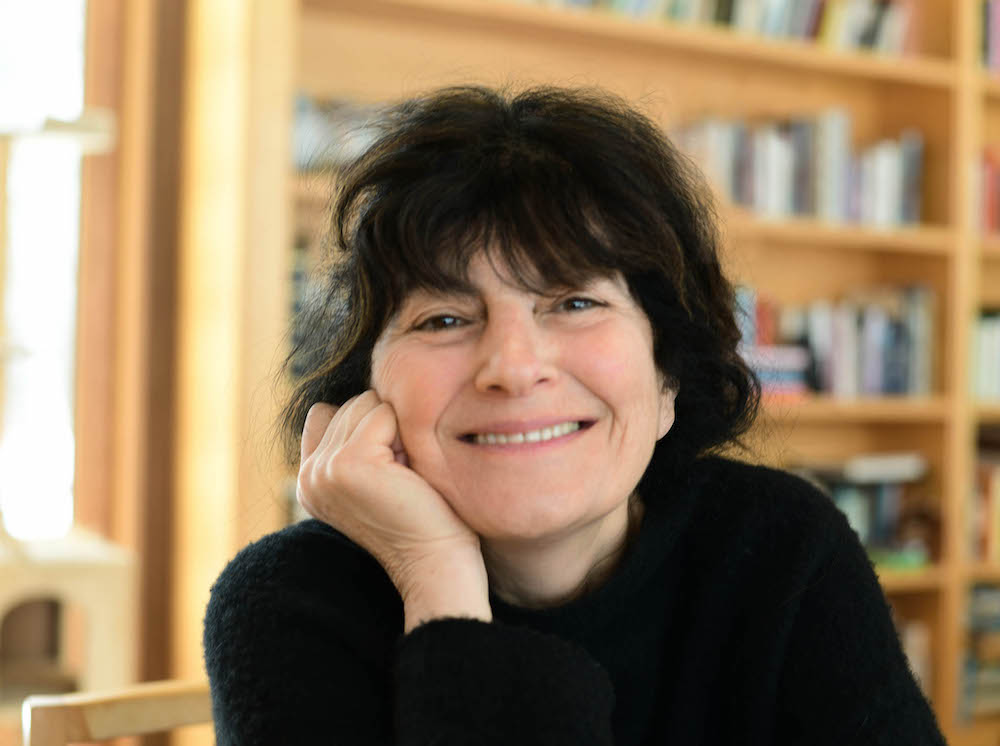
Ruth Reichl. Photo: Michael Singer. © Michael Singer.
from The Paris Review http://bit.ly/2WCJ18X
Comments
Post a Comment