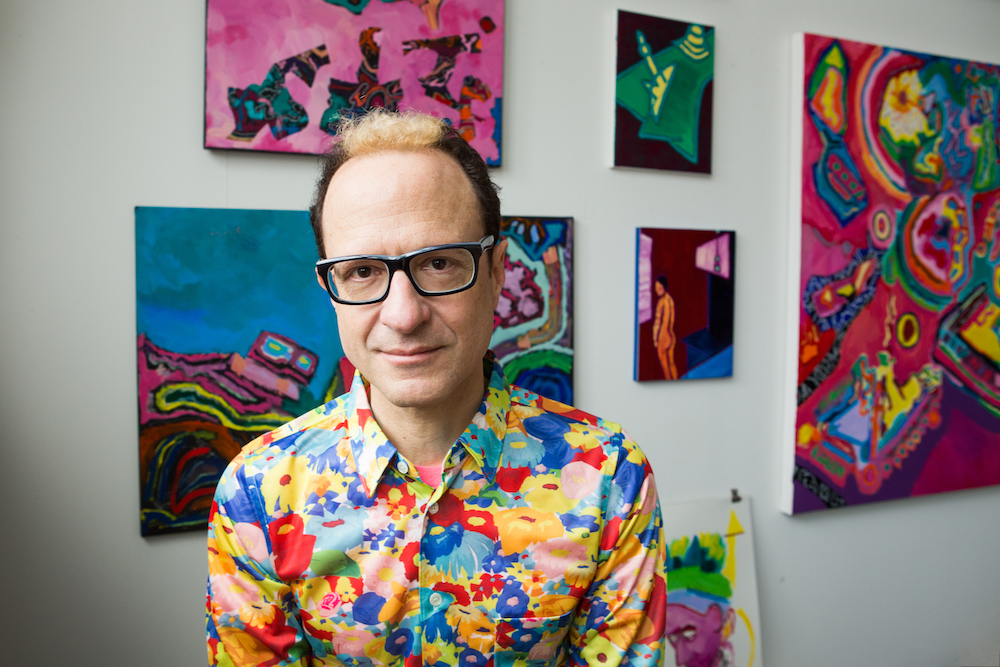
Wayne Koestenbaum. Photo: Ebru Yildiz.
Wayne Koestenbaum has written many books, and even recorded an album. I’ve seen him psychoanalyzed before a large, rapt audience. He does a lounge act, of spoken word and Scriabin. He paints. Among his glittering and varied oeuvre (and for Koestenbaum, oeuvre can be the only word used here), there is only one novel: Circus, or, as it was previously known, Moira Orfei in Aigues-Mortes.
The first time I met Wayne Koestenbaum was just after this novel initially appeared, almost fifteen years ago. He was reading from it at a bookstore. He wore, for his reading, a white pleather café racer’s jacket. It was raining that night. His jacket looked worthy to repel water but featured no hood, its semi-rain-worthiness a mere symptom of its primary function, which was to throw light. Koestenbaum and this book seemed like vessels containing an unusual combination of erudition, elegance, irreverence, and, in welcome measure, a touch of sleaze.
Later, I recall people comparing Moira Orfei to Nabokov’s Pale Fire and the novels of Genet. I believe that means they approved. I approve, too, but I find those comparisons useless. Koestenbaum’s unique aesthetic orbit, his humor and thematic range, cannot really be understood by such refractions, although if I had to compare it I’d say his humor is like Bataille’s. “Don’t get your hopes up,” Theo Mangrove, the narrator of Circus, implores. “The object in your hands is not a novel.” But don’t believe Theo, either. The object in your hands really is a novel. But it retains the force of its language even when its words are pulled apart, left to sweat, in Mallarméan marmalade:
the flawed
the almost
the
…..not
……..quite
…………..No one loves Baked Alaska
…………..Heartlessness is a symbol
……………..Soiled time
Pink sweater set
…………………………………………………………………..Primary ruin………………………………………………………Immortality clause
……………………………………………………Jerking off, I canceled reality
a) Describe
….. b) Disappear
Here is the basic design: resident of scruffy East Kill, New York, and diarist filling notebooks with “East Kill persiflage,” Theo Mangrove is either a former renowned concert pianist or a pianist who never had any renown, a patient who may or may not be getting electroconvulsive therapy, a scribbler who may or may not be writing in direct address to his absent mother, Alma, herself either a world-renowned pianist or not. Regardless of things the reader cannot verify, Theo is plotting a return to the stage, with Moira Orfei, the internationally celebrated Italian circus diva, in Aigues-Mortes, a small town in the Camargue.
Theo writes to Orfei, awaits her reply, cruises “the water district” (chance encounters, declining property values), adjusts his Aigues-Mortes concert program, shops for the clothes in which he will mark his return to the stage (a velvet suit purchased at Jacob’s Ladder, East Kill’s finest purveyor of men’s clothes). His home, a primal scene he shares with his mother, his sister, who never leaves the house, and his wife, seems something like a Grey Gardens, but a lot smaller, and with no Kennedy, and instead, a dreamer—Theo—with a Kissinger-size death drive, who lives in a dimension called the comeback.
What is a comeback? A future shaped and steered by fantasy, ego, and erotics. A mad plot to redeem reality, correct the record, save face, and fix fate. In Theo’s case, his impending comeback, in the form of a piano concert and circus performance with Moira Orfei, is the leading edge of time’s three-part clock (past, present, future). It hovers, like a mirage on the road, eternally in front. And as you will learn when you reach the incredible end of this novel—a conclusion of suddenly classical and crushing effect—Moira sees the free-floating status of the future as if she were a god.
*
Will Theo play Rachmaninoff, Scriabin, or Liszt? Will he apologize to his sister for defiling her when they were young? Will he secure a phone number for Moira Orfei?
I don’t want to give too much away. But I will warn and excite the easily offended that nothing here is sacred except art and language. Theo has HIV, and spreads it. Of Matilda, his aunt, with whom he has a sexual relationship, Theo says: “She told me about the time she threw an infant across the room. Babysitting … Years later she apologized to him, a stockbroker.” He brags that his new piano student is only mildly retarded. (“Start her with Hanon,” he muses.) Complains that his sister, Tanaquil, once again played the incest card. Amid the more sordid features of his life, and mental life, Moira flaunts triumph. Aigues-Mortes, with its salt, its ramparts, its arcades, waives redemption. “What is Tanaquil’s Aigues-Mortes?” Theo wonders, in a moment of unusually tender interest in his sister.
Moira’s own letters, interspersed throughout the book, read as if in the voice of the Subject Supposed to Know. “If you think I don’t exist,” she tells Theo, “think twice.” That the circus diva Moira Orfei is real (lived to eighty-three, is buried in the Veneto) and is also, for Koestenbaum, a coded transposition of someone else—the opera singer Anna Moffo, Koestenbaum’s own chosen diva—is perhaps the most mysterious feature of this novel. Orfei, the real Orfei, was still alive when this book was published. She died in 2015. The following is from her obituary in the Telegraph:
Known for her over-the-top use of garish cosmetics, her bouffant hair and extravagant outfits, in later years she became something of a gay icon, much imitated by Italian drag queens. She even featured in a novel, Moira Orfei in Aigues-Mortes (2004), by Wayne Koestenbaum, as the object of obsession of a homosexual concert pianist.
Let us bracket homophobia for a moment to correct the obituary as to Theo: he’s more than “a homosexual.” He’s a son. A brother. The heir to a modest dairy fortune. A husband. Roamer of East Kill’s water district. A devotee and dreamer.
Back to the obit:
A likeable, motherly woman, who was particularly fond of her troupe of dwarfs, Moira Orfei remained hugely popular with circus audiences and towards the end of her life would enter the ring in a large chauffeur-driven car, to wild cheers.
Let’s bracket the sizeism of this obituary to think of Theo as one of Moira’s dwarfs. Or perhaps he is the chauffeur, and in that imagining, let’s assume the car was—naturally—a Duesenberg, gleaming and klaxoning its way into the circus tent, Theo in his driver’s gloves, hands on the wheel, with Moira in the rear, waving out the window.
In the wake of that image, I start to regard this novel itself as an obituary, although it was written more than ten years before Moira Orfei died. But then whose obituary is it? Is it the obituary of Theo’s fantasy, which will never align with the real? Theo himself seems an imperishable object, a sustaining note. His family contract, he tells us, has “an immortality clause.” If desire is immortal, so is Theo immortal, as he waits, and hopes, for metaphor and music to take shape, give expiation.
In that sense, this book is his prayer.
And though he doesn’t know it, since he can’t escape its pages, the book itself is that same prayer of his, answered.
Rachel Kushner is the best-selling author of The Flamethrowers, a finalist for the National Book Award and a New York Times Top Ten Book of 2013; Telex from Cuba, a finalist for the National Book Award; and The Mars Room, a finalist for the Man Booker Prize. She lives in Los Angeles.
Copyright © 2019 from the introduction to Circus or, Moira Orfei in Aigues-Mortes: A Novel. Reprinted by permission of Soft Skull Press.
from The Paris Review https://ift.tt/2G4NwDg
Comments
Post a Comment