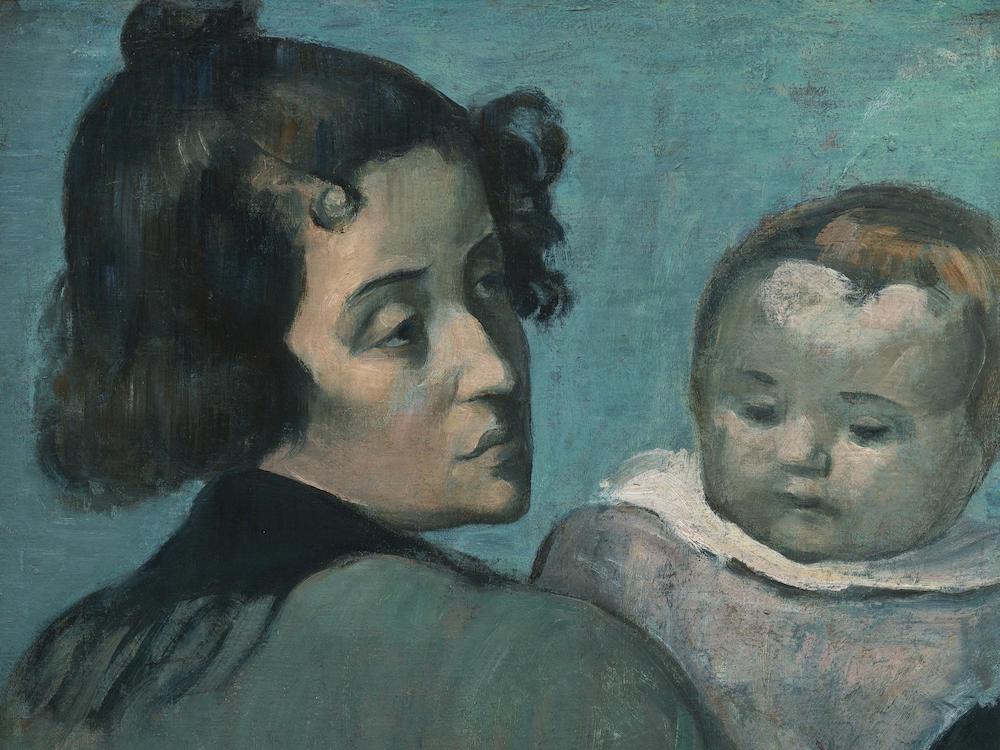
Émile Bernard, Mother and Child, 1898, oil on canvas, 15″ x 18″. Public domain.
“What did you have?”
“A boy.”
“Congratulations.”
If your first child is a girl I’m told people say: “How nice.” How nice. My child is of course wonderful but I am also—embarrassingly—slightly proud that he’s a boy. Childbirth is full of such pitfalls, where the wish to be congratulated overrules common sense. I don’t find the standard notion of the good wife very compelling. But the pressure to be “a good mother” according to the prevailing definitions is practically irresistible. I can keep my head when David Holbrook, in his most recent outburst against “art, thought and life in our time,” warns that it is a failure in mothering that produces intellectuals and other pornographers: it’s less easy to steer a clear course through all the varied strictures of the psychoanalysts themselves. Worse still, it’s by no means adequate to try to behave like a good mother, because that involves an act of will: goodness itself is supposed to emerge. Before Bowlby, you had only to keep your children clean and set a decent moral example. Now ordinary selfishness is thought somehow to be expelled in the moment of delivery, or sooner: it’s selfish, you’re told by the masked figures gathered expectantly around you, if you can’t manage without forceps. Better mothers don’t need them.
It’s logical enough. Since having children is a matter of choice, or, some might say, a deliberate self-indulgence, there is an obvious obligation to do the best one can by them. What worries me is that logic is so seldom invoked: naturalness, spontaneity are the mots d’ordre. Which hardly takes into account the fury one may feel at an infant who rages when he should be feeding, and indeed would like to be feeding if only he could stop raging. On the other hand, I find little consolation in the knowledge that if on these occasions I were to act on what I take to be my “natural” inclination and batter my baby, the law would return a verdict of diminished responsibility and I wouldn’t go to prison: I’d rather go to prison. But why is “natural” taken to be a synonym for “good”?
I accept that much of what I’m saying could be ascribed to puerperal paranoia, with the proviso that the form the paranoia takes derives from current attitudes. According to New Society it’s a rare father who can change his child’s nappy. Until children reach an age where they can be reasoned with, the only notices fathers get are good ones. I like changing my son’s nappy—foolish of Freud not to pay more attention to Jocasta’s part in the relationship. But sometimes I wonder why I’m thought to have a special scatological aptitude. People ask me eagerly if I enjoyed feeding him myself: I didn’t. The first weeks of feeding were often very humiliating (I’ve never felt so sympathetic to men’s fears of impotence), particularly when the humiliation was repeated every three hours. Now I’m proud of being a self-sufficient life-support system—farmer, wholesaler, restaurant, and waiter—but initially I felt as if I’d been pinned to a conveyor belt serving a remote and self-obsessed baby. Eager to cram something into my own mouth, I took up smoking; a friend in the same situation started biting her nails.
I’d read plenty of articles about mothers getting upset when their children grow up and leave home, but it seemed a bit much to resent his leaving the womb. Still, he’d been mine before and now I was his. I couldn’t sleep without his permission, I ate for his sake rather than mine, I felt guilty if I took an aspirin, and if I was late home it was as if I was capriciously denying him his means of existence. If I got upset his provisions were threatened, and if the provisions were threatened I got upset. In addition, he was admired and I was dilapidated. Child-rearing manuals have a section on the importance of the mother making the father feel that he, too, has a relationship with the new child—but it was six weeks before I felt I had a relationship with the child myself. My husband was the supervisor, a position that left him free to enjoy the child. “For Dockery a son,” I thought, with uncharitable memories of Larkin’s poem.
In short, I didn’t get depressed because I couldn’t cope, as the books said I might: unless things are really bad you can always grit your teeth and make yourself cope. I got depressed because instead of maternal goodness welling up inside me, the situation seemed to open up new areas of badness in my character. Perhaps pediatricians believe in the power of positive thinking: I’ve always found it harmful. There’s nothing magical about a mother’s relationship with her baby: like most others, it takes two to get it going. Once the baby begins to enjoy feeding, once it starts responding to situations in a way that you can understand and smiling huge smiles and playing and “talking” and watching, then you begin to feel the famous warm glow. Before that you’re on your own, and the least “natural” thing in the world is suddenly to change your character.
Mary-Kay Wilmers cofounded the London Review of Books in 1979 and has been its sole editor since 1992. After a childhood spent in the United States, Belgium, and England, Wilmers went to Oxford to read French and Russian. Initially planning on a career as an interpreter, she instead found work as a secretary at Faber & Faber in the time of T. S. Eliot, then moved on to The Listener and the Times Literary Supplement, and contributed to the New Statesman, before cofounding the LRB. She is the author of The Eitingons: A Twentieth-Century Family, a book about her family and their Cold War deeds and misdeeds, which the Telegraph called “transfixingly readable.”
Excerpted from Human Relations and Other Difficulties: Essays, by Mary-Kay Wilmers. Published by Farrar, Straus and Giroux, August 27, 2019. Copyright © 2018 by Mary-Kay Wilmers. Introduction copyright © 2018 by Orlando Books Ltd. All rights reserved.
from The Paris Review https://ift.tt/2KZEx9d
Comments
Post a Comment