
Nick Tosches in a Trench Coat

Nick Tosches, music writer and biographer, died at the age of sixty-nine on Sunday.
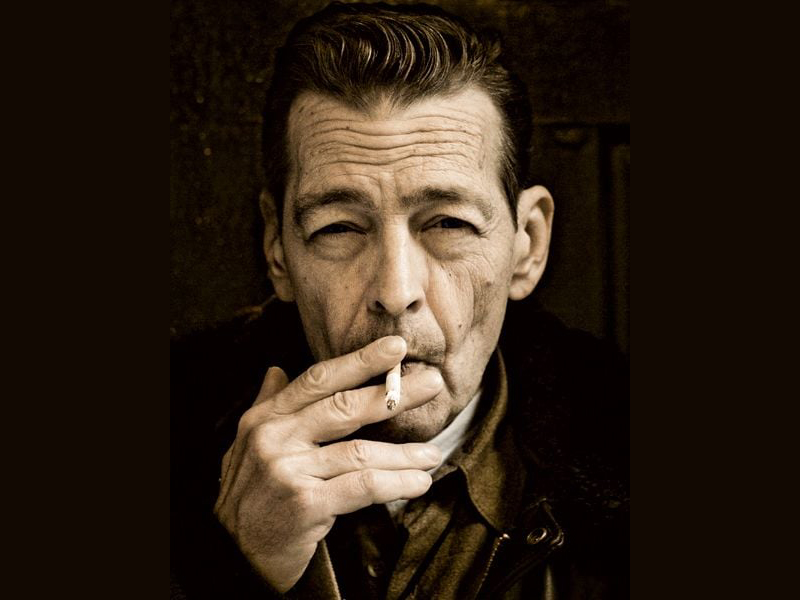
I spent an awful lot of time around Nick Tosches in the late seventies. We’d wind up in the same places, we were published in the same crummy magazines, and we’d stumble into each other at St. Mark’s Bookshop or the Bells of Hell or Gem Spa. It was always midnight, and he almost always had a book in his pocket, maybe The Twelve Caesars or Ovid, and a wrestling magazine.

I lost touch with him, but kept up with his writing, or tried to. After Hellfire and Dino and a few other astonishing books, his prose got overheated, but somehow undercooked. He’d throw a handful of twenty-dollar words and twenty-five-cent ideas up in the air, sort of hoping they’d take wing, but if they didn’t, he’d get bored and just watch them tumble to the ground, stare at them sadly, kick a few over to see if they were still breathing, then wander off to get a smoke.

Though he wrote some of the best and most evocative books on music, his real gift was for rooting around the back rooms, the hustles, the shadows and the half-truths that make up the underbelly of show business. If the devil was in the details, he was perfectly happy to dig through the devil’s briefcase and read the fine print of the love letters and girlie magazines he found inside. He was part accountant, part private eye, part stumblebum, but his passion was contagious, and he always listened to the B-sides.

Last I saw him, he seemed fragile, a shadow of himself, but once he smiled, he was back. He was more than back. He seemed pleased to see me, and there was a kindness in his eyes I hadn’t noticed before. I was looking forward to watching him grow old and cranky.

I ran into him outside a small luggage shop on Bedford Street, near his favorite bookshop. He was wearing a trench coat the color of wet sand. The belt was hanging loose, and his hands were deep in the pockets. He nodded, as if we were already in the middle of a conversation.

“A lot of room in these pockets. You’d be surprised. I could pack a Beretta in here,” he said.

“Or a picture of one. In one of those little bedside frames you get at Woolworth’s,” I replied.

“Don’t forget. I’m from Newark.” He tilted his head and narrowed his eyes. “I know where to get …” He left the thought hanging. It hung for a little too long.

“Guns?” I suggested.

“Frames. Really nice frames.”

Brian Cullman is a writer and musician living in New York City.


from The Paris Review https://ift.tt/35OBTLL

Comments

Popular posts from this blog

The Sphere

Photograph by Elena Saavedra Buckley. Once when I was about twelve I was walking down the dead-end road in Albuquerque where I grew up, around twilight with a friend. Far beyond the end of the road was a mountain range, and at that time of evening it flattened into a matte indigo wash, like a mural. While kicking down the asphalt we saw a small bright light appear at the top of the peaks, near where we knew radio towers to occasionally emit flashes of red. But this glare, blinding and colorless, grew at an alarming rate. It looked like a single floodlight and then a tight swarm beginning to leak over the edge of the summit. My friend and I became frightened, and as the light poured from the crest, our murmurs turned into screams. We stood there, clutching our heads, screaming. I knew this was the thing that was going to come and get me. It was finally going to show me the horrifying wiring that lay just behind the visible universe and that was inside of me too. And then, a couple se...

A Year in Reading: Daniel Torday

I’ve been on leave from teaching this year, so it’s been a uniquely good 12 months of reading for me, a year when I’ve read for only one reason: fun. Now when I say fun … I’m a book nerd. So I tend to take on “reading projects.” The first was to work toward becoming a Joseph Conrad completist. I’m almost there. I warmed up with critic Maya Jasanoff ’s The Dawn Watch: Conrad in a Global World , which granted me permission to remember the capacious scope of his perspective, his humanistic genius. His masterwork was hard work, but Nostromo belongs on the shelf of both the most important and most difficult of the 20th century. The Secret Agent blew the top of my head off—it’s funny and deeply relevant to our moment, about a terrorist bombing gone horribly wrong. Under Western Eyes is all I got left. 2018 isn’t over yet. But then much fun came in reading whatever, whenever. That started with a heavy dose of Denis Johnson . The new posthumous collection of his short stories, The Lar...

The Historical Future of Trans Literature

  Whatever happens against custom we say is against Nature, yet there is nothing whatsoever which is not in harmony with her. May Nature’s universal reason chase away that deluded ecstatic amazement which novelty brings to us.  —Michel de Montaigne If you were trying to get anywhere in the late thirteenth century, the Hereford Mappa Mundi would not have been particularly helpful; the map is rife with topographical omissions, compressions, and errors—the most egregious of which is perhaps the mislabeling of Africa as Europe and vice-versa. Of course, as any medievalist will tell you, mappa mundi were not intended for cartographic accuracy anyway. Rather, they were pictorial histories, encyclopedias of the world’s mythological and theological narratives, records of medical fact and fable. Notable places—Carthage, Rome, Jerusalem, Alexandria, Jericho—appeared, but their placement on the map emphasized their symbolic import, rather than their geographical specificity. Thus, ...