
The Evil Stepmother

We’re away until January 6, but we’re reposting some of our favorite pieces from 2019. Enjoy your holiday!
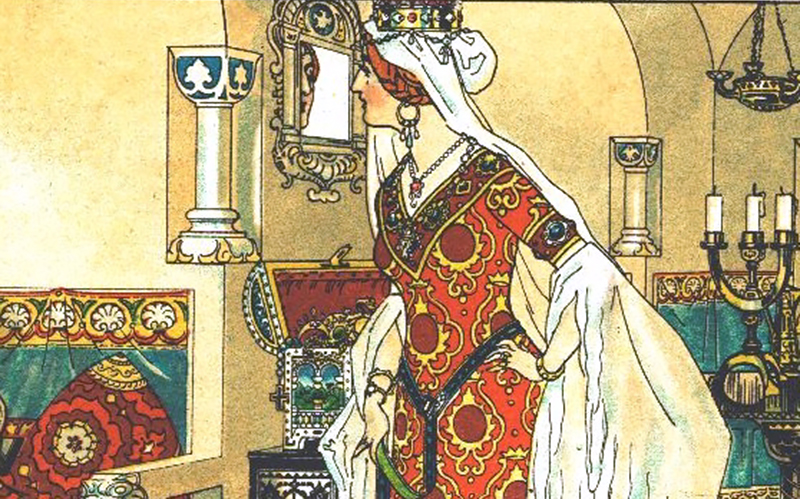
Franz Juttner, Illustration from Snow White, c.1905

The stepmother swings like a light bulb back and forth, causing the mother who is not there to glow. That is her job.

I am a mother, a stepmother, and a step-stepmother because I am my husband’s third wife and he has daughters from his first marriage and a daughter from his second. And I am a mother-mother to our two sons. “This isn’t one of your fairy tales,” my husband once said to me during an argument. He didn’t mean Disney, he meant Grimm. He meant I was stowing myself in the body of a fairy-tale stepmother and setting sail.

When all my husband’s daughters are in our house at once, I grow very small. The weight of those girls who are not mine tilts the house and slides me toward the door. The weight of my sons slides me back in. Up and down goes this seesaw. My husband takes no turns. He grows weightless and blurry.

On weekends, my seventeen-year-old stepdaughter comes out of her bedroom in the early afternoon in a thick white robe. She moves slowly, like a gathering cloud. My sons worship her. She is soft and kind, and they scramble all over her body like mice. “Play with us,” they beg. She yawns. Shuffles into the bathroom. They wait by the door. Often she is in there for a long, long time. Her name is Eve, like the first woman on earth.

I love my stepdaughter, but I don’t love being a stepmother. It’s grim work. If we stood side by side, Eve and I, and looked into the mirror, it wouldn’t be our reflections staring back at us. It would be something wild and cruel. A discarded mother skin. A punishment for loving what doesn’t belong to you.

Read more >>


from The Paris Review https://ift.tt/2PT0toO

Comments

Popular posts from this blog

Dressing for Others: Lawrence of Arabia’s Sartorial Statements

Left: T. E. Lawrence; Right: Peter O’Toole in Lawrence of Arabia (1962) In the southwest Jordanian desert, among the sandstone mountains of Wadi Rum, there is a face carved into a rock. The broad cheeks and wide chin are framed by a Bedouin kuffiyeh headdress and ‘iqal, and beneath the carving, in Arabic, are the words: “Lawrence The Arab 1917.” If you are visiting Wadi Rum with a tour guide, you can expect to be brought to this carving. You may also be shown a spring where Lawrence allegedly bathed, as well as a mountain named after his autobiography, The Seven Pillars of Wisdom, whose rock face has been weathered into a shape that does, from some angles, look a little like a series of pillars. I am familiar with the legend of T.E. Lawrence—fluent Arabist, British hero of the Arab Revolt of 1916, troubled lover of the Arab peoples—as well as with the ways the Jordanian tourism industry has capitalized on this legend. Nevertheless, I am still surprised when I hear someone mentio...

23 Notable Kiswahili Novels

Kiswahili is spoken widely in Eastern Africa and parts of Central Africa. The language has morphed into different dialects spoken in these countries and is well documented in a rich literary tradition. Even though this collection centers on 20th century fiction, the Kiswahili literary tradition spans various genres and time periods. Swahili novels known as […] from Brittle Paper https://ift.tt/2TFnCfP

The Beautiful Faraway: Why I’m Grateful for My Soviet Childhood

At 10 I wanted to be an artist, practiced a hysterical form of Christianity, talked to trees, and turned a sunset at a local park into a visionary experience. My great-aunt lured me to Evangelical Christianity with the strangeness of Gospel stories where Jesus always ended up angry at his disciples’ failure to understand. I sympathized with being misunderstood, and latched on. Besides, Christianity was a forbidden fruit in Soviet Russia so I had to worship in secret. This was unnerving but also alluring. I was a breathless romantic who wanted to be surprised by a knight on a white horse. From the early ‘80s to the early ‘90s, my childhood was formed by the images, atmosphere, and allusiveness of Soviet songs. I grew up in an artistic family where emotions flew high. I was the kind of imaginative child who could spin an entire tale from an oblong stain on the kitchen table. But there’s more to it than that. My family was not always idealistic or romantic, especially not in New York in...