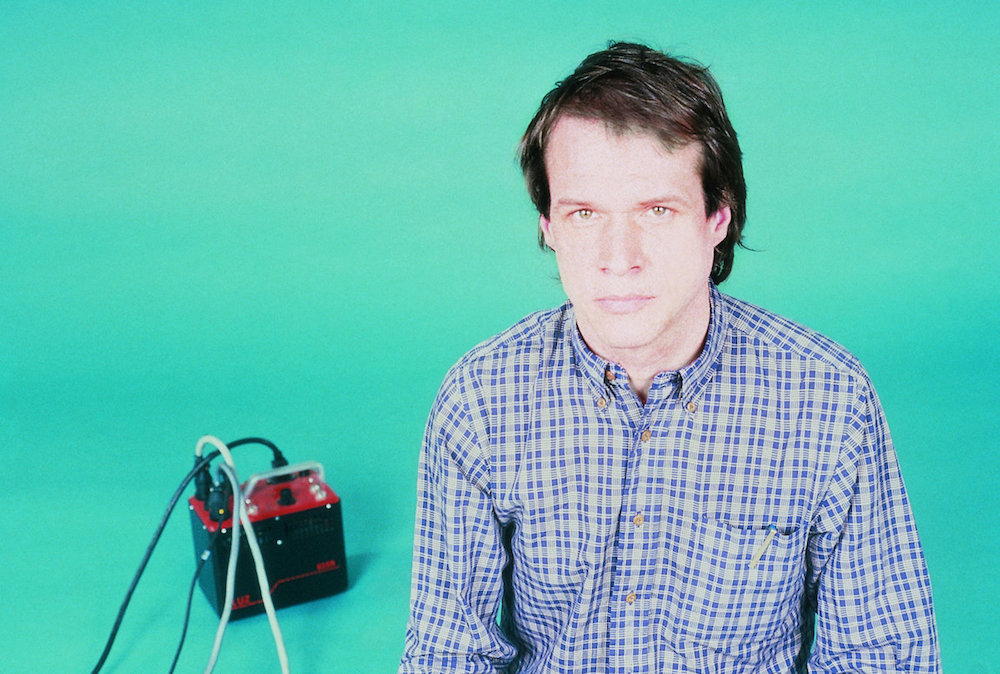
Arthur Russell.
There’s a man on the ferry. He’s wearing jeans and a baseball jacket, and standing at the stern, his handsome face pitted with acne scars. Everyone else is looking at Manhattan. It’s 1986: the twin towers dominate the view. But this man isn’t looking at the buildings. He’s staring at the swirling water, the confluence of tides, the East River and the Hudson coming together in the harbor of the city.
Out here, everything is expansive. Out here, everything falls away. He has his Walkman in his pocket, his headphones around his ears. The music he’s listening to is a mix he finished late last night. When he was done—though nothing he does is ever done, exactly—he took the cassette and left the studio. Full moon, of course. He has been recording this album every full moon for three years now. Sometimes he curls up in the studio for a nap, waking in the small hours with a new idea, an unprecedented sound bubbling through his mind.
His name is Arthur Russell. He’s thirty-five. He’s a gay man, a Buddhist, a cellist, a country singer, an avant-garde composer, a disco queen; he is the greatest musician you’ve never heard of. The music he’s been making doesn’t sound like any music that’s ever been made before. It’s like music from the bottom of the ocean, it’s like music they play in nightclubs on the moon. The album he’s working on, his first, is called World of Echo. Just his voice and his cello, in a studio in the deserted Financial District, surrounded by empty, glowing offices. One man pushing music to its limits, finding the breaking points, making the most beautiful songs imaginable and then teasing them apart like taffy, amplifying and distorting until they dissolve into lakes of sound.
In the booth, he listens tensely, moving his shoulders a little, dancing on the spot. Which is best? How does the cello sound when it’s distorted, feeding back like an electric guitar? How subtly can he bow, making gauzy veils of sound? Is it better when you can hear the words he’s singing, or when there’s no intelligible language at all, just a polysyllabic babble, the music pouring through him?
At two or three or four in the morning he stops and slots in the night’s tape, listening to it repeatedly as he prowls the sleeping city. Sometimes he’ll walk for hours, wandering the streets of SoHo or following the river north. Maybe he’ll stop at Gem Spa and buy an egg cream; maybe he’ll call in at Paradise Lounge or the Garage, where the beautiful boys dance, black and white together, in an ecstatic sweaty fusion.
*
Lately, though, Arthur has been losing his taste for the nightlife; lately he’s been feeling dog-tired. So tonight he finds himself on the ferry at dawn, gazing out at the water, loving how the music sounds over the low drone of the ferry’s engine.
He doesn’t come from here. He’s a farm boy, a refugee from the cornfields of Iowa, seeking his fortune in the big city. He never felt like he fitted in in Oskaloosa and at eighteen he ran away from home. He washed up in a Buddhist commune in San Francisco, where he was forbidden to play his cello and so hid in a tiny closet to practice for hours. In 1973, at the age of twenty-two, he made the move to Manhattan, finding an apartment in the Poets Building, a tatty East Village walk-up that was home to the poet and counterculture legend Allen Ginsberg, who encouraged him to come out as a gay man.
The wake of the boat is white. Arthur leans on the rail, dreaming of his future. What he wants is to be a pop star, though he is hampered by his shyness, his lack of money, his perfectionism, and his refusal to compromise on any aspect of his vision. Most musicians stick to a single scene but Arthur has always been a rover. He’s a restless soul, sticking his nose into all the different places in the city where music is made. Boundaries and borders mean nothing to him; he hurdles them with ease.
Within a year of his arrival in New York, he was appointed musical director of the Kitchen, the venue at the heart of the city’s experimental music and performance scene. He collaborated with minimalist composers like Philip Glass and Steve Reich, and at the same time he played dirty downtown rock ’n’ roll, running out to CBGB to play cello with the Talking Heads. Any music could be experimental music; any music could be pushed to its limits.
And then he discovered the hedonistic, libidinal world of disco. All across downtown, nightclubs were proliferating: wild spaces where you could sweat with a thousand strangers, relinquishing inhibitions in a nocturnal world of rhythm. Quickly, he began to release dance records, under multiple pseudonyms. Dinosaur L, Loose Joints, named for the constant cry from the dealers in the park by his house. Indian Ocean, Killer Whale: names for alternate selves, each with their own alternate vision. You could dance to these records, sure, but they were also experimental adventures in minimalism in their own right: spacey, dubby, weirdly unstructured grooves, shifting in mood from high-octane, fist-pumping ecstasy to a more childlike, innocent sensuality.
Listening to World of Echo over the sound of the water, he thinks it is the most complete thing he’s ever done. But it’s never easy to put something new into the world. The album is released later that year and though the early reviews are positive the sales are appalling. There is no market for the music of the future, not yet.
*
One of the most magical things about Arthur Russell’s music is the way it conveys feelings, especially feelings that are not easily translated into words. For him, music is a place of refuge, a haven: an infinite realm into which he can voyage, even vanish. He hopes it might bring him fame, heightened visibility, but he also loves the way he can swim out into it, temporarily disappearing from the world.
AIDS accelerates this tendency, turning it malignant. His natural spaciness becomes confusion, while his capacity for wandering gives way to a dangerous tendency to get lost. The virus lays waste to him, eroding his immune system. The end comes fast: April 4, 1992, in a hospital bed high above New York.
How do you define success? Arthur Russell was only forty when he died, flat broke, a few obscure singles and one album to his name. But he left behind thousands of hours of unpublished music, hundreds upon hundreds of songs. In his absence, it has slowly been released into the world, to growing appreciation and acclaim. Listening to it now, it becomes apparent that the quiet man on the ferry, dancing silently to sounds that only he could hear, might have been one of the best and strangest talents of twentieth-century composition, a nomad with an absolute commitment to freedom, whose natural element was music itself.
“That’s us,” Arthur once sang, “before we got there.” He’s telling a story about being a kid, driving to the lake before dawn to swim. Then the beat kicks in, and now it’s love he’s singing about, or maybe just how it feels to be awake in the world on a summer morning. It’s a wild combination all right, and so was he: a firework on the Fourth of July, everything all at once, in a flash, and gone before you could grasp what you’d seen.
Winner of the 2018 Windham-Campbell Prize for nonfiction, Olivia Laing is the author of three previous books of nonfiction, including The Lonely City, and one novel, Crudo. Her work has been translated into fifteen languages. She lives in London, England.
Excerpted from Funny Weather: Art in an Emergency © 2020 by Olivia Laing. Used with permission of the publisher, W. W. Norton & Company, Inc. All rights reserved.
from The Paris Review https://ift.tt/3bu1MCs
Comments
Post a Comment