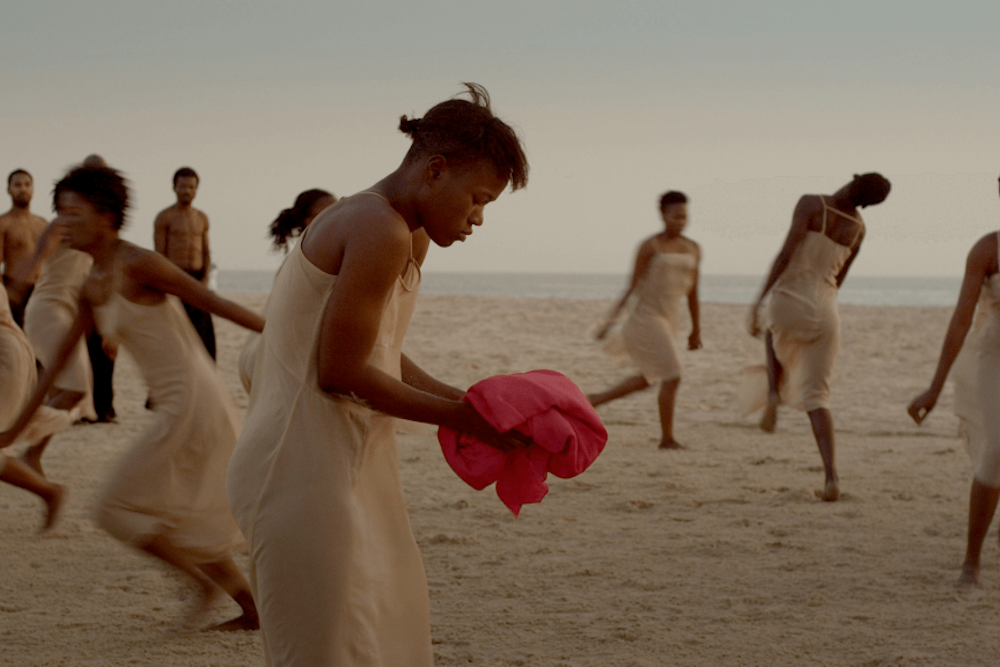
Film still from Florian Heinzen-Ziob’s Dancing at Dusk—A Moment with Pina Bausch’s “The Rite of Spring.” © polyphem Filmproduktion.
In March, a formidable troupe of thirty-eight dancers from fourteen African countries was preparing for a world tour of Pina Bausch’s 1975 The Rite of Spring. The pandemic interrupted plans for international travel just before their opening night in Dakar. But the group nevertheless made the best of the situation, moving operations to a neighboring beach for a final run-through before cameras. The result: Dancing at Dusk, a thirty-nine-minute dance film available on Vimeo through July. Bausch’s Dionysian choreography, with its invigorating and relentless rhythms, unearths dark truths about human relationships and suffering—themes only intensified by the prelockdown timing of the performance. While the entire ballet is an athletic feat, Anique Ayiboe’s performance as “the chosen one” is particularly impressive, her rhythmic convulsions giving body to the tresillos and syncopations of Stravinsky’s score. At the end of her solo, she leans forward on a dangerous incline, her arms outstretched. As if pushed by the last spattering of chords, she collapses, and the ballet ends. The sun is nearly set, and a thin sliver of ocean delineates sand from sky. The film crew erupts into slow applause as the tired dancers limp toward one another, laughing and embracing. On the day of this performance, the world, too, was on the precipice of a collapse. But as I watched the dancers embrace, I was reminded that there may yet be some hope, some eventual time for shared recovery. —Elinor Hitt
I think that saying “I love history” is a bit like saying “I love art”—a generic “about me” statement from a college student’s 2005 Facebook profile—but damn it, I do love history, particularly when it’s combined with my favorite art form, fiction. So when the writer Kaitlyn Greenidge says she began writing novels as a way to democratize access to history, I am, as I believe is still said, here for it. When she goes on to talk about exploring absences in the archive through fiction, I am even more emphatically so. Greenidge says all of this and more on the most recent episode of BOMB’s excellent podcast, FUSE, in conversation with the artist and filmmaker Ja’Tovia Gary. Gary, in turn, describes an approach to film that brings pieces of history directly into contact with the present to probe the idea of inheritance; she mixes footage she shoots herself with archival film, including segments that she alters to make her own by scratching, bleaching, and painting them. The two talk about the work of identifying and unsilencing stories—Gary’s within her family and Greenidge’s from American and Haitian history. Their exchange leaves the listener impatient to experience their works in progress but, in the meantime, inspired. —Jane Breakell

Still from Disclosure: Trans Lives on Screen.
There were so many small things to mourn when the world came crashing to a halt this spring—weddings postponed and trips canceled. Among them, for me, was the ability to see my friend Sam Feder’s documentary Disclosure: Trans Lives on Screen play at the Tribeca Film Festival. Luckily, it’s now on Netflix, and it’s perfect viewing for this strange period, when our attention flickers between the television shows that evaporate into our changeless days and the disintegrating country outside our windows. Ostensibly about the history of trans representation in cinema, the documentary, like any unassailable thesis, folds in so much more: questions of race, of the strange yet indelible desire to see people who look like us on screen, and of how the culture we consume shapes our understanding of the world. Anyone who is not a white cis man in this country has taught themselves, perhaps unconsciously, to read between the lines of Hollywood films. In exchange for the chance to see people who look like us, or love like us, experience joy, we have learned to block out the tortured, Hays Code–inspired endings that befall characters who transgress society’s rules. Disclosure explores how these transgressions of gender have been coded into moving pictures for as long as the pictures have moved—and how our beliefs and laws have, in turn, been moved by them. One gay friend, after yet another difficult conversation with his conservative mother, sent her a link to Disclosure along with the note: “I’m not trans, but I experienced a lot of these same things, and this will help you understand me better.” It is a film that might help all of us understand ourselves better. —Nadja Spiegelman
God, do I love Phoebe Bridgers’s debut album, Stranger in the Alps. I fell for it hard when I was working on bringing her into the studio so she could record a piece for the next season of The Paris Review Podcast (more on that when … well, when people are able to gather in places like recording studios again). Then I got deep into her other projects and began eagerly awaiting her second solo record, the just-released Punisher. Here’s the thing: musically, Bridgers is not reinventing the wheel, but it’s a great wheel, and she’s a melodic virtuoso with a songs-of-innocence voice that delivers grown-up songs of experience. Bridgers is, to my ear, among the best contemporary lyricists, keeping company with Ani DiFranco, Richard Buckner, Sufjan Stevens, and her collaborator Conor Oberst, all while looking back toward Joni Mitchell. After about ten listens, I’ve fallen hard for Punisher, too, but I’ll admit I was initially put off by the slick production. On Alps, every song feels mostly like a person played it in front of a mic; Punisher is awash in layers of Pro Tools and keyboards and inarticulable effects. But the same simple, bottomless songwriting is at work. My current favorites are “Garden Song” and “I Know the End”—the first and last tracks—and maybe “Halloween,” a soft, dreamy song about the freedom of disguises. I suppose I would have preferred another record like Alps, without the next-big-thing costume on, but Bridgers is a real and profound artist, and I’ll gratefully follow her wherever she’s going. —Craig Morgan Teicher
You sit in the theater, waiting for the play to begin. As the audience grows impatient, an actor appears and announces a delay. They reassure you: the play will begin soon. Five minutes later, “one thousand men” enter and attack the audience. The play is called Intolerance. The sequel follows the same pattern, except it is called The French Revolution. The tickets “are priced at a figure accessible only to a particularly well-to-do class of theater-goers,” and the audience is attacked as they stream out to the lobby, “where the usual French Provincial furnishings will be appropriate.” Such are the barbed twists to be found in the knockout Collected Poems of Lorenzo Thomas, edited by Aldon Nielsen and Laura Vrana, which puncture the “polished surface of civility.” Along with Calvin C. Hernton and Ishmael Reed, Thomas was a young member of the Umbra Workshop, and he straddled, or was claimed by, various avant-gardes: the Black Arts Movement, the Language poets, and the New York School. However, Thomas plays with and confounds his labels; after one of these titles, Harryette Mullen called him “the definitive poet of the Marvelous Land of Indefinitions.” Thomas is “a collector / Of tones,” and the five hundred pages of his collected poems cover such ground, such range, that I am left with a contradiction of adjectives. These poems ring with the thunder crack of wit and invention. They are “a housecall on a troubled century.” Thomas mocks the veneers of Western literature, of “thinking in strong but well-scrubbed Germanic / Words adopted by romantic conversation … to counterfeit a long melodious decay / We might call Art or serious concern.” It is dull and violent and cruel, “living under a weird tradition / of Europe’s stifling conceit,” and Thomas’s restless experimentation and strange shifts embody these disjunctures and come with a “vow to concoct new mythologies / That wouldn’t / Forge us such raw cruelties.” “Ancestors do not go away / You say they are here / It is not even a question / Of return,” he writes. “All silence says music will follow.” —Chris Littlewood

Lorenzo Thomas, center. Photo courtesy of Kelly Writers House, via Wikimedia Commons (https://ift.tt/OiVsm5).
from The Paris Review https://ift.tt/30oUo7x
Comments
Post a Comment