In March, The Paris Review launched The Art of Distance, a newsletter highlighting unlocked archive pieces that resonate with the staff of the magazine, quarantine-appropriate writing on the Daily, resources from our peer organizations, and more. Read Emily Nemens’s introductory letter here, and find the latest unlocked archive pieces below.
“It’s back-to-school time. This year, of course, that doesn’t mean everyone is actually going back to school. Many students and teachers are attending class from one side or another of the same screen that for months has been their primary aperture on the wider world. Some schools and universities are still completely remote; others have managed to bring students back in some capacity. And so this new school year begins with a roiling mix of excitement, trepidation, anxiety, and hope, for students, parents, teachers, and staff. No matter the situation, it’s not the same as a bunch of students sitting together in a room, carefree enough to focus solely on what they’re learning. But I like to think there are some aspects of education that can be practiced no matter where and with whom one finds oneself. Literature can offer deep, reflective engagement with the thoughts and feelings of others; a kind of call-and-response across space and time that is not unlike conversation; and opportunities to (safely) visit near and faraway places. In that spirit, this week’s The Art of Distance features interviews that celebrate education. ‘Singing school,’ as W. B. Yeats called it, is always open and available to all. May you find these interviews as enriching, enlightening, and sociable as a good school day. And let’s meet up by the lockers after third period.” —Craig Morgan Teicher, Digital Director
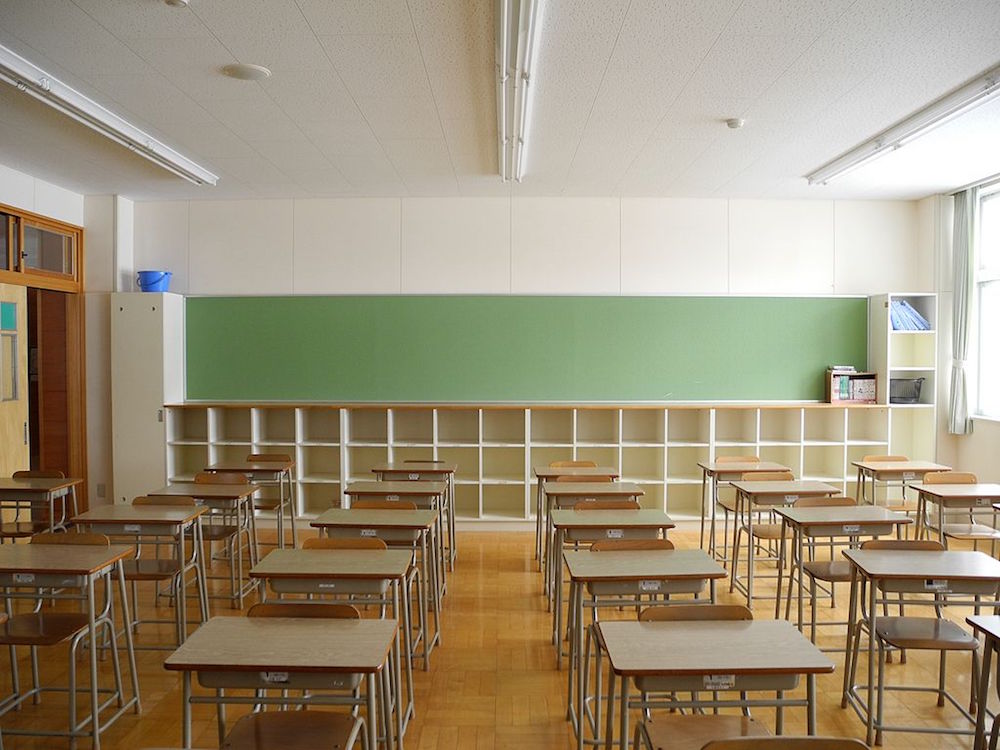
Photo: Douglas P Perkins. CC BY (https://ift.tt/1mmxEyy).
Unsurprisingly, writers have high regard for education, though also, nonconformists that they are, great ambivalence about it. But all the writer-teachers of this asynchronous virtual master class believe strongly in the dialectic encounter that can take place in a classroom or in conversation with a text. Please raise your hand if you have any questions.
Early in his writing life, the Nobel laureate Kenzaburo Oe set himself a kind of lifelong homeschool curriculum, as he explains in the Art of Fiction no. 195: “When I was in my twenties, my mentor Kazuo Watanabe told me that because I was not going to be a teacher or a professor of literature, I would need to study by myself. I have two cycles: a five-year rotation, which centers on a specific writer or thinker; and a three-year rotation on a particular theme. I have been doing that since I was twenty-five. I have had more than a dozen of the three-year periods.”
Toni Morrison explains, in the Art of Fiction no. 134, the high bar she sets for her students: “When I teach creative writing, I always speak about how you have to learn how to read your work; I don’t mean enjoy it because you wrote it. I mean, go away from it, and read it as though it is the first time you’ve ever seen it.”
In the Art of Fiction no. 52, Bernard Malamud attests to the two-way street of education: “Schools meant a lot to me, those I went to and taught at. You learn what you teach and you learn from those you teach.”
“One of the things I love about teaching at Syracuse,” says George Saunders in the Art of Fiction no. 245, “is that you meet class after class of talented young people, and it makes you an optimist. And you get to give that kind of student a sort of lineage advice—you get to pass on to them ideas like, Yes, you are responsible for every single line. You are. No one else will be.”
Finally, there’s Robert Hass, who in the Art of Poetry no. 108 acknowledges problems with higher ed but professes his love for the academic life: “There are many things wrong with the university as an institution, but it’s been the place for me. I love the idea of people studying everything and experimenting in labs with everything. To be part of that enterprise has always seemed to me like a gift.”
Sign up here to receive a fresh installment of The Art of Distance in your inbox every Monday.
from The Paris Review https://ift.tt/32Ox8Cs
Comments
Post a Comment