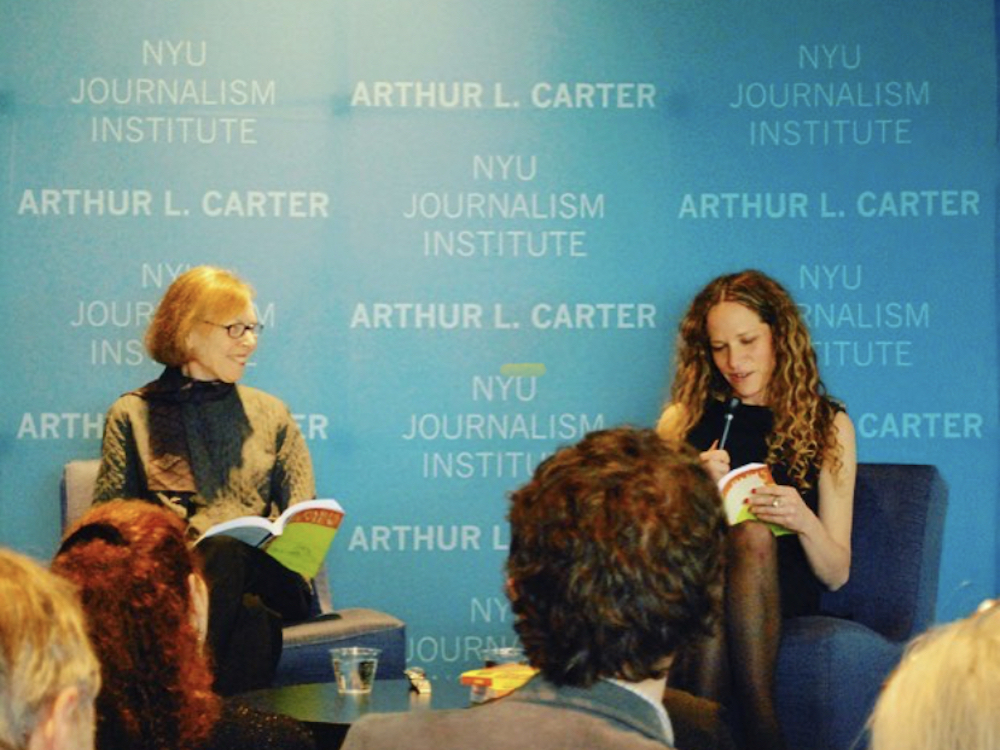
Janet Malcolm and Katie Roiphe in conversation at NYU, 2012. Photo courtesy of Roiphe.
In one of my last email exchanges with Janet Malcolm, in one of the darkest parts of the pandemic, she wrote to me, “I can only try to imagine the hard time you and the children are having. How can you not be stalled on writing? I wish there was something I could do to help.” Her response warmed me, elevating my state of general stagnancy into something almost socially acceptable. The idea of her in my house, helping with my son’s online schooling—his teacher was reading out “rat facts” during his daily forty-five minutes of Zoom—was so incongruous that it made me laugh.
Before I met Janet, she was the only living writer who terrified me, because I loved her work so much. I had devoured The Silent Woman in graduate school, and then read everything else. I was in awe of her brutal precision, her sharp inquiries into the production of stories, her moral wrangling with journalism and biography. H. G. Wells once said that Rebecca West wrote like God, and I always felt a little like that about Janet Malcolm.
The Paris Review had tried to interview her twice, but she had pulled out of the process both times. She was not comfortable being recorded by an interviewer in a ranging conversation, and only agreed to my interview if we conducted most of our exchange in writing. We wrote our questions and answers back and forth over months. We came to love the nineteenth-century, evening-post rhythms of our exchange, and at some point in the course of our emails we became friends. I noticed that she had none of the usual writer’s vanity, exhibitionism, need for attention. She constantly deflected the conversation away from anything too personal. She was more interested in craft, in the exchange of ideas. As our interview went into proofs, Janet noticed that my questions and observations had been radically whittled down in the edit. She objected. “You become characterless,” she wrote to me. She threatened to pull the interview once again. There was no doubt in anyone’s mind that she was serious.
In the interview, I asked her to talk, among other things, about the conflicts between motherhood and work. “I have indeed felt the pull between the ruthlessness of the writer and the instincts of the mother,” she said. “But this may be too deep a subject for an e-mail exchange on the art of nonfiction. Probably the place to discuss our struggles with the art of mothering is a dark bar.” I never got to have that conversation with her, or to go to a dark bar. Instead, we’d have lunch at Choshi, the now-closed sushi restaurant near her house, where we talked about my messy life (never hers, despite my best efforts) and writing and work. She gave me tips on my hopeless interviewing style. “You don’t have to be friends with everyone you interview!” she would say. “If someone suggests going off the record, tell them you don’t want to hear it. They’ll probably talk to you anyway.”
She was known for her sharp eye, her gorgeous sentences, her frightening brilliance, her astonishing reporting, her fierce intellectual presence, her ability to cut through people’s pretensions with a single phrase, but she was also generous, warm, supportive, and kind. Months after our interview, she offered to participate in an afternoon of live Paris Review interviews at NYU. She dreaded public conversations, but she knew that I was embroiled in a fraught tenure process, and that the conversation might help make me seem valuable to the university and its endless committees. I had somehow managed to corral Gay Talese and Lorrie Moore into the evening as well, and the idea was that they, too, would be informally interviewed onstage. Janet, set against the dangerous spontaneity of casual conversation, insisted that she and I read our interview like a play. There was something sublime and deranged about this arrangement, but there was also an elegance to her solution: she had found a way to be both present and not, at the same time. We sat there and read our parts.
Katie Roiphe is the author, most recently, of The Power Notebooks, and the director of the Cultural Reporting and Criticism program at New York University.
Read Janet Malcolm’s Art of Nonfiction interview, which was conducted by Roiphe.
from The Paris Review https://ift.tt/3zN73lF
Comments
Post a Comment