Over the course of Villa Albertine’s Proust Weekend, a series of talks, workshops, and readings celebrating the forthcoming English translation of the last volume of the Recherche and the centenary of Proust’s death, I ate more cakes per diem than usual: on Sunday afternoon, a miniature pistachio financier, a Lego-shaped and moss-textured cake that reminded me of the enormous chartreuse muffins at my college cafeteria; on Saturday morning, a crisp, disc-like, almond-sliver-sprinkled shortbread cookie with a hole, which reminded me of a Chinese coin; and, on Friday night, at a holiday party, a dish of Reddi-wip and sour cream studded with canned mandarin slices and maraschino cherries apparently called ambrosia salad. It reminded me of the music video for Katy Perry’s “California Gurls.” But these were really only preliminary research exercises for the episode in which Proust Weekend was to culminate: a “Proust-inspired madeleine event with surprise guests”!
In the meantime, I attended some panels. When Lydia Davis was beamed in to talk about her award-winning translation of Swann’s Way, I stared at the cat in the lower left-hand corner of the screen. In order to be properly Proustian, I knew, the center of an experience would be hidden in the margins of the event itself. The events of the Weekend transpired in the second-floor ballroom of the Gilded Age mansion that houses Villa Albertine, the French embassy–adjacent artist’s residency program that had organized the event. Most attendees were, I gathered, elderly residents of the Upper East Side and/or miscellaneous French people. The Payne Whitney Mansion seemed like a memory palace designed expressly for the contents of the Recherche: ceilings bordered by Rococo botanical motifs as rhizomatic as Proust’s syntax; or a purple-carpeted grand staircase bookended by two urns of exotic flora that reminded me of Combray’s psychedelically hued asparagus (“steeped in ultramarine and pink, whose tips, delicately painted with little strokes of mauve and azure, shade off imperceptibly down to their feet”).
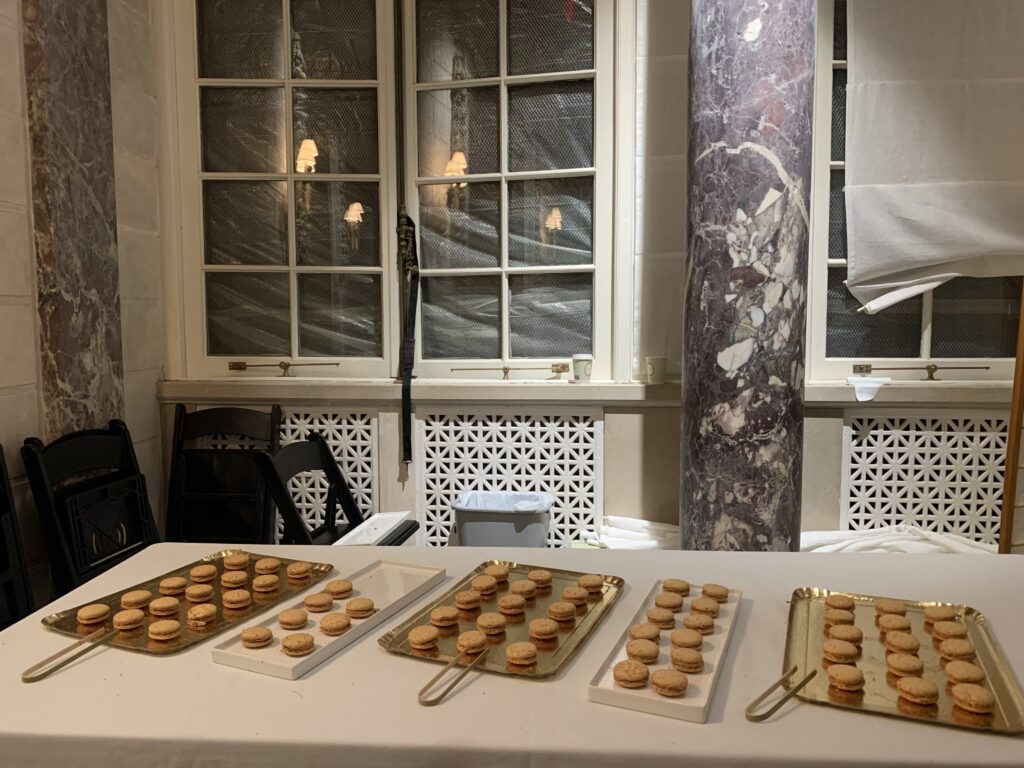
On Sunday at four, Proust Weekenders would be getting an exclusive “first taste” of a special collaboration between Villa Albertine and the Ladurée pastry franchise: a madeleine-flavored macaron. I’m not sure why macarons were chosen instead of madeleines—perhaps because “macarons,” according to the president of Ladurée US, Elisabeth Holder, “are the supermodels of the food industry.” As I took my seat in the ballroom, I recalled all the Ladurée products I had consumed in the past year: most recently, rose petals suspended in a luminous pink jelly, on my birthday, which is also the date of Proust’s death; a turquoise macaron that I selected from a box of six others because I knew it was called the “Marie Antoinette”; half of the “Champs-Élysées Breakfast” served at Ladurée Soho (disgusting); approximately ten or twelve macarons of various colors, at an event for which I signed an NDA on an iPad at the door; and, last winter, an orange-colored macaron with a tiger printed on it. This last macaron, a Lunar New Year limited edition of some Asian flavor (mango? passion fruit?), gave me pause. Whenever I go into a Ladurée, the store is filled with Asian girls making their Asian boyfriends take pictures of them with their macarons—just like me. The franchise called Paris Baguette is actually Korean. The most recognizably Japanese fashions are strange perversions of those once worn at Versailles. Why do Asian girls love French things/sweets so much? I wondered, not for the first time.
Meanwhile, the madeleine event had begun. And the Villa Albertine had a surprise for us: there would be not one but three madeleine reinterpretations to be tasted tonight! We clapped and cheered. We were hungry. The interpretations sat on a small table at the front of the ballroom, arrayed in order of height. Behind them sat three French pastry chefs.
Pastries, it seems to me, are the perfect food for interpretation. Their distinct exterior shapes and conventionally determined flavors provide a set of coded forms ready-made for culinary rereadings: like the deconstructionist Dominique Ansel’s “cookie shot,” milk poured into a vessel made out of cookie. I think people love variations on a classic because they like to perceive forms and contents being playfully recombined on the normally nonliterate medium of their tongue, remixing their memories to psychedelic effect. (In East Asia, novelty reinterpretations of Western sweet foods, like wasabi-flavored Oreos, are peculiarly popular.) Fancier pastries are often adorned with quirky semiotic flourishes, in which ingredients inside the pastry are present in quasi-symbolic form outside of it, like candied tea leaves topping a tea-flavored tea cake. The madeleine, though, is a humble cookie made from brioche dough and shaped like a shell. It is basically birthday cake–flavored, which, when it comes to cakes, is like having no flavor at all. So I was skeptical of Ladurée’s madeleine-flavored macaron: was the soft madeleine, like the crisp macaron, not defined primarily by its texture? Was a madeleine-flavored macaron not oxymoronic, like a lemon-flavored orange? (It would have been more Proustian and Modernist, I thought, to make a madeleine in the shape of a paving stone, using, somehow, molecular gastronomy.)
Before we could taste these treats, another panel. The interpretations were explained to us. Chef Sebastien Rouxel, from the team at Daniel Boulud, had added Grand Marnier to the basic madeleine recipe and made a large loaf version of the cake. Chef Eunji Lee, who recently opened her own patisserie, Lysée, created a medium-size madeleine with a soft caramel center and a toasted brown rice glaze, in honor of her French Korean identity. And Chef Jimmy Leclerc, from Ladurée—the tallest of the three but the creator of the smallest pastry—was there to represent the madeleine-flavored macaron. The three chefs told us memories from their childhoods. Then they told us even more stories from their lives, which included transcontinental immigrations, detours into military service, and patisserie apprenticeships much more difficult than either of these. Questions were asked, jokes were made, and, at last, we were released into the Marble Room, where, meanwhile, three silver platters bearing Leclerc’s and Lee’s inventions, plus three silver urns dispensing hot drinks, had appeared on the Villa’s ivory tablecloths. (Rouxel’s loaf we would receive to go, as a party favor to share with loved ones.) I gathered my treats on a Ladurée logo’d napkin.
I put each one in my mouth one by one. The “hot” chocolate, though promisingly thick and sweet, was actually cold, like NyQuil. The unlabeled herbal tea tasted what I can only describe as “herbal.” Lee’s madeleine tasted like “yellow cake.” Ladurée’s madeleine-flavored macaron tasted more like a macaron than any macaron I’d ever had: crunchy and then soft, its center like butter mixed with sugar. Though I enjoyed each of these moments of the madeleine event, I did not have an experience of form, content, Proust, life, or literature—or really of anything, aside from pure sugar. Had I, in my research, eaten so many sweets in the past forty-eight hours that I was anesthetized to their reverie-inducing qualities?
I was about to get back in the now-dwindling pastry line for a second try when I was invited on a private tour of the mansion, which would end on the roof. Feeling vaguely sedated, as though the cocoa really had been NyQuil, I followed the dapper director of the Villa Albertine, plus the three chefs, up a long flight of stairs painted in a rainbow gradient of Ladurée macaron colors—Pistache, Citron, Rose, Cassis—until we emerged into the twilight above Fifth Avenue. The Midtown skyscrapers were all lit up for Christmas. Below us, the park was dark. The air was cold and bright. The sky was a color somewhere between Marie Antoinette and Cassis: it was beautiful. I gasped. So did the three chefs. The director took a TikTok (I think).
The wind whipped around me, I clambered over some kind of ventilation pipe, and I remembered, all of a sudden, Olivier Assayas’s Irma Vep, in which Maggie Cheung, on Ambien and wearing a black latex catsuit, runs around at night on the roof of her Paris hotel. Cheung basically plays herself: a Hong Kong kung fu–flick actress who has been cast as the lead in a reinterpretation of a classic French film. It is the best acting I’ve ever seen: Cheung, who barely talks, manages to be both perfectly Oriental and something else behind that Oriental person that no one, on the screen or watching it, can really see. I remembered how, watching it, at sixteen, an age when I was “obsessed with Godard,” was the first time I really felt Chinese. And, as I shivered, because I was in fact attired in only a thin, cheetah-print catsuit, many of the details that had so randomly struck me over the course of that weekend, like Lydia Davis’s cat and Ladurée’s tiger flavor, reemerged and rearranged themselves, like the chemical transformations produced by cooking. I did not remember, until that moment, that when I, like Proust’s hero, have to go to bed earlier than my insomnia allows, I will smoke weed and listen to one of the five thirty-minute-long poetry readings by the Chinese American poet Tan Lin that I have downloaded to my phone. My favorite track is a poem in Seven Controlled Vocabularies in which Lin eats at a molecular gastronomy restaurant whose chef “is young and looks like a cowboy reincarnated as a skateboarder.” Why do Asian girls love French things/sweets so much? I do not know, but, until then, there on the roof, I had forgotten that I started this nightly listening practice when I was seeing someone trained as a French pastry chef who would sometimes, being a baker, leave my apartment before sunrise to work, waking me, and I realized that my taste for experimental poetry and therefore, indirectly, for Proust, was inextricably tied to desiring someone whose ambition was to make a psychoactive weed croissant, which is such a good idea. Language acts on you in surprising ways when you only hear it half-asleep. I realized that I had, over many nights, perfectly reproduced all of Seven Controlled Vocabularies somewhere in my memory. Cats feature in the book, as does being Chinese. I was grateful to Chef Eunji Lee, whose yellow-flavored psychoactive madeleine must have made me more Asian than I had previously realized. “The ideas of food erase the food itself and then become the food you did not think you were eating,” Lin said on the roof, in my head. “Off to one side of the fruit was smeared what looked like hot fudge sauce except that it was made of ketchup and jalapeno peppers. The sauce was semi-frozen. The sauce was hot and cold and cold and hot I couldn’t tell which. I put the pineapple in my mouth and it was like eating something that was once a vegetable.” I thought of wasabi-flavored Oreos, and M. Swann’s lover’s house full of Oriental flowers, which she loves for their “supreme merit of not looking in the least like other flowers, but of being made, apparently, out of scraps of silk or satin.” And as the sky above Central Park darkened, finally, to an inky color unknown to the kitchens at Ladurée, I had found the thought I had nearly forgotten, which is that I am really most Asian when I am asleep, or eating a macaron.
Olivia Kan-Sperling is an assistant editor at The Paris Review.
from The Paris Review https://ift.tt/PnowVtv
Comments
Post a Comment