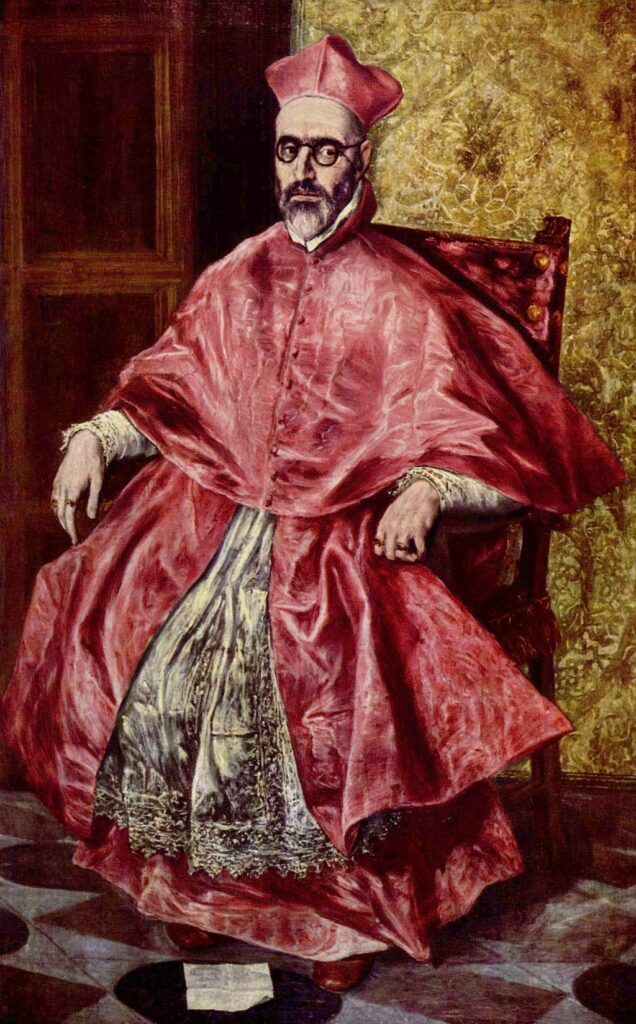
Cardinal Fernando Niño de Guevara, El Greco. Courtesy of Wikimedia Commons.

Don Carlo is the kind of opera that has gone out of fashion. I cruised through half-empty rows when I saw it last fall, just days after attending a packed-to-vibrating weeknight production of The Hours – , the two-act opera adaptation of a 1998 novel and its 2002 film adaptation – promoted heavily on the subway and. Verdi’s four-hour-long political tragedy, set during the Spanish Inquisition in the sixteenth century, feels more like eating your operatic vegetables. Its place in the canon was actually secured by the Met, whose onetime general manager Rudolf Bing fished it out to open the 1950 season.
Based largely on a historical play by Friedrich Schiller, Don Carlo imagines a backstory to some real events in the life of Carlos, Prince of Asturias, who was briefly engaged to Elisabeth of Valois before she instead married his father, King Philip II of Spain. Schiller invented an anachronistic friend for Carlos: Rodrigo, Marquis of Posa, who distracts the heartsick prince with the political cause of Flemish independence. Meanwhile, Philip, bitter and paranoid over his loveless marriage, contemplates getting rid of his son and his treacherous friend with counsel from the blind and ruthless leader of the Inquisition.
Among the work’s Shakespearean qualities—Anglophone audiences might especially recall Hamlet—is the fact that there are multiple versions of it, in both French and Italian. Verdi revised it several times between 1866 and 1886. The original libretto is in French—Don Carlos—but its five-act runtime tested even nineteenth-century audiences. Verdi then lopped off the entire first act, which shows Carlos and Elisabeth’s coup de foudre in the forest of Fontainebleau. Act 2 of the original, which became Act 1 of the more widely performed Italian translation that I saw, starts soon after Philip’s wedding, when Elisabeth has become the queen of Spain—and Carlos’s stepmother. The Met experimented with the five-act French version last season, but has since backtracked to its repertory standard. Skipping the first act deflates the opera’s romantic plot—turning the love triangle between Carlos, Philip II, and Elisabeth into mere inciting incident—but heightens its political and religious drama.
Eponym aside, Don Carlo is more vessel (for Rodrigo’s ideas) and pawn (in his father’s power games) than protagonist. Crucially, in this drama of Enlightenment values, he appears deeply irrational. He loses his composure within the first act and practically faints onto his stepmother, singing, “I love you, Elisabeth! The world is nothing!” Freeing herself from him, she counters, “Well then! So, wound your father! Come, soiled by his murder, drag your mother to the altar!” Into this void enters Rodrigo, who radiates s Reason and extols liberty, particularly for the downtrodden people of Flanders. “Lend your aid to the oppressed Flanders!” he exclaims. As they pledge their commitment to the cause in a spirited duet, Carlo seems barely conscious that he’s signing on for treachery against his own family.
Both Schiller and Verdi, who was an ardent Italian nationalist, treat Rodrigo, the avatar of their latter-day values, indulgently. Though he ends up being assassinated for his political intrigue, Verdi sends him off with a poignant aria where he sighs, “Io morrò, ma lieto in core”—I die with a happy soul. Rodrigo’s activist zeal must have seemed a little quixotic even in the nineteenth century, after the Revolutions of 1848 were so decisively snuffed out, but he’s newly compelling in our age of liberalism in crisis. At times, Rodrigo seems like the opera’s conscience; at others, like an opportunistic interventionist avant la lettre. When he decries the plight of Flanders, it’s impossible not to think of the contemporary war in Ukraine—whose geopolitical intrigue, soon after my viewing, became linked, strangely enough, to a mysterious cyberattack on the Met—or, on the other hand, of our recent wars of so-called liberation in the Middle East.
I’m getting a little off-topic, but grand opera—the nineteenth-century tradition of historical operas with lavish sets and an epic sweep—is, among other things, a serious invitation to contemplate such matters as state power and history. The cause of Flanders, introduced as randomly to the weak prince as to the audience, doesn’t stay abstract for long. The production unleashes all its powers of spectacle to show the terrifying core of the Inquisition, the auto-da-fé. Amid joyful fanfare—“This happy day is filled with gaiety!” sings the chorus—Flemish Protestants in long pointed caps are led to be burned at the stake. The director, David McVicar, stylizes sixteenth century Valladolid as a cement-gray metropolis, with rows of dystopian arches that recall Mussolini’s Rome. Pity the people who live under such a cruel yoke, and pity them again that their fates will be determined by such weak and shiftless men as Carlo and Philip. What grand opera also does, with its scale (even when lightly abridged) and its mix of the dramatic and the marvelous, is prepare us to confront, with heightened sensibilities, a vision of evil—as opposed to workaday badness, weakness, or fallibility.
Philip’s study, dominated by an outsize Christ on the cross, is the site of the climactic exchange between the aging, paranoid king and the awesome, terrible Grand Inquisitor, who wrestle with the crown’s relationship to the altar. The Inquisitor—played by John Relyea, incarnating one of opera’s great villainous basses—introduces himself through an octave, somewhat reminiscent of the stone guest who comes to punish Don Giovanni. When Philip asks if he must sacrifice his son, whom he fears both as a romantic rival and a delusional political liability, the Inquisitor reminds him, without missing a beat, that “God sacrificed his own son to save us all.”His impregnable authority puts the royals’ petty maneuvers in context: “Everything bows and is silent when faith speaks!”
No one can be a hero when the church and state are such a rock and hard place. Tyrannical institutions box off every character’s choices. It’s not even clear what “duty” means, under these circumstances—what is owed, and to whom. The character who seems best adapted to them is Elisabeth, who recognizes “the emptiness of the vanity of this world.” But her stolid acceptance is not exactly rewarded, because the authority she accommodates and subjects to is rotten, craven, and truly evil. Different people get the last word in different versions of this opera, but in the original, it belongs to the monks of San Yuste, who observe that even a great emperor has become no more than “dust and ashes.”
Krithika Varagur is the author of The Call: Inside the Global Saudi Religious Project and an editor of The Drift.
from The Paris Review https://ift.tt/YEeUHqr
Comments
Post a Comment