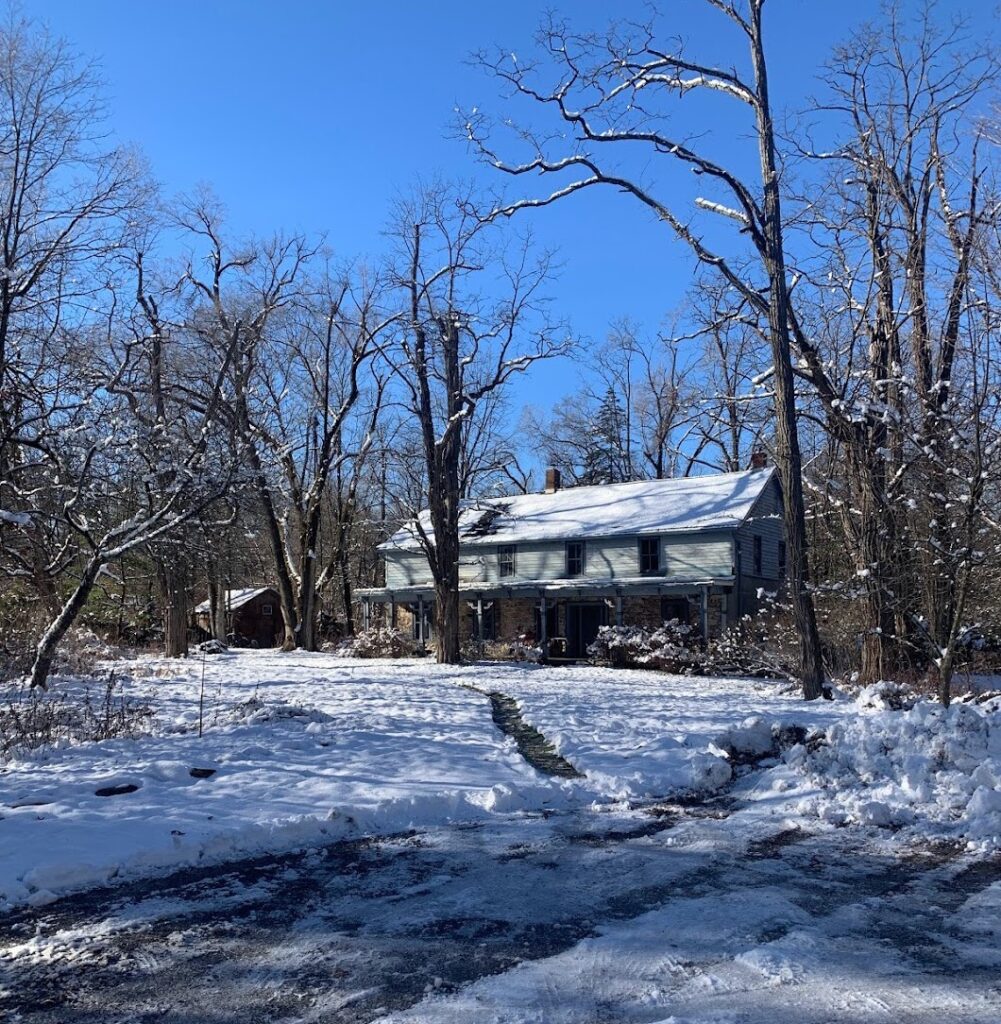
Photograph by Hannah Gold. Carolee Schneeman’s house near New Paltz.
In 1965, a stone house near New Paltz was slated for auction. A cousin of the owners, a young and broke painter, begged them to let her buy it with her musician partner. She feared the house, which was limping along, would be torn down. Soon after the artists purchased the house, the painter heard a voice in her dreams: Take a chisel to the concrete stucco, and you will find golden stones beneath; use a crowbar to peel up the linoleum flooring, there are chestnut boards below; hammer at the drop ceilings, there are wide beams above. The painter did as she was told, and found what she was promised. The house began to breathe again. The painter lived in, or perhaps with, the house for more than five decades, long after the musician departed. There were other lovers, and a series of cats—some of the cats were reincarnations of the previous cats. She made films in the rooms and worked in a studio on the second floor. She became, in time, famous. Four years ago, she died in the downstairs bedroom.
This is the story, anyway, as told by the painter, who was known to take creative liberties. Carolee Schneemann named herself. “I made it up,” she said of the surname, “I wanted a big masculine German name.” She was born in 1939, if not 1934. Her birth certificate seems to have been altered with one careful pen stroke, closing off the four into a nine. Census records concur. Still, even last winter, at her first retrospective in the U.K., the Barbican’s Carolee Schneemann: Body Politics, the museum materials showed the later date, the one Schneemann used when she told her life story.
Last December, I saw the house myself. Rachel Churner, the director of the Carolee Schneemann Foundation, picked me up at the station and drove me to Rosendale, New York, where Rachel Helm, who caretakes the house, met us. There was snow on the ground, and we stomped what we could off our boots before the Rachels began my tour. Helm pointed first to the exterior stones Schneeman had uncovered, and then, inside along the walls, the horsehair insulation, coming unstuffed like a child’s favorite plush toy.
The house was built, I learned, in the 1750s. One of three on the street, it was constructed when the French Huguenots made a deal with the Lenape. The Huguenots designed these houses with sloped entries to the basements for livestock to enter—the animals’ body heat would rise, helping to warm the rooms above. In the 1820s, the town became the cement capital of North America, and the industry supported the community until the early twentieth century, when Rosendale cement fell out of favor. The town grew quiet. The house expanded upward and sideways, a patchwork of extensions and renovations, and there was a farm on the property—the farm failed. Finally, the young Schneemann, along with pianist and composer James Tinney, purchased the house.
On the first floor, I saw low-ceilinged rooms enlivened by bright colors: paisley or other swirling patterns clashed joyously; two vibrant shower curtains hung paired on the rod. Directly beneath, along the tub’s base, Schneemann had installed tiles with images of male knights and pages upside-down—“to castrate them,” Helm said.
By the bookshelves upstairs, Churner showed me the notes and indexes Schneemann made in the backs of her books—one listed each reference to cats. On a short stretch of peeling gold wallpaper hung Schneemann’s thermometer collection, and through the next door was the winter bedroom, painted a dusty lilac, a shade Schneemann considered shadow-proof. I recognized the deeply recessed windows from Fuses, one of Schneemann’s most famous works.
In the film, the artist and Tinney have sex in the winter bedroom, as the cat Kitch watches. “No one else had dealt with the image of lovemaking as a core of spontaneous gesture and movement,” Schneemann later wrote, and Fuses does chronicle sex as a kind of improvised choreography, with pauses on the bodies in repose, the camera slowly scanning Tinney’s pubic hair the way one might capture the details of a larger painting. In the mid-sixties, of course, this exposure was radical, and the reception of the film, now in the permanent collections of MoMA and the Smithsonian, was mixed: it was alternately degrading, liberating, and even educational.
The purplish hue of the winter bedroom, immortalized in Fuses, recurred in the houses’ palette alongside deep yellow, seafoam green, and the bluer end of periwinkle. The downstairs bedroom is floral; the wallpaper was a wedding gift to one of the nineteenth-century tenants. In spots where the design had faded, Schneemann matched the bosc-pear hue with paint and penciled a partial restoration of the branches. Most surfaces throughout the house reflected this level of care: she’d also rubbed paint into the shower’s grout, dyeing it a pleasing blue, and the bathroom wall is decoupaged, as is the kitchen backsplash—the former appears in Fuses. The latter is composed of sesame seed, tamari, and Chiquita labels, alongside images of painted food, all sealed in a clear coat of green. Beneath the backsplash, Tinney constructed a cabinet, designed around a single vintage drawer that Schneemann had found on a city street. Tinney also built the kitchen table, a boxy J shape, around a stone pillar in the center. “And for him to do carpentry was such a big risk because, you know, his delicate little fingers,” Helm said, rolling her own in the air, as if on a piano.
Walking through the house with the Rachels felt dreamlike; there was something kaleidoscopic about the rooms, the sort of adulthood a child might dream of, in which walls are canvases, and treasures found while walking (feathers, shells, pebbles, nests) are proudly displayed. But it wasn’t juvenile at all; it was skillfully executed, a creative work accomplished by an artist over decades.
Alongside the artist’s found treasures are the rodent offerings of her feline housemates—Schneemann was adamant that the cats were not her pets: Kitch the cat, not Kitch her cat. I spoke to Alexa Punnamkuzhyil, who once looked after the final cat, La Niña, when Schneemann was away. Punnamkuzhyil is actually allergic to cats, “but you don’t say no to cat sitting for Carolee Schneemann.” She recalled the feminine energy of the house, the way the dangling crystals on the candleholder refracted rainbows on the walls, and Schneemann’s instructions, Punnamkuzhyil says, “to not disturb any of La Niña’s scatter pieces or any artwork he might make while we were there.” Artwork by La Niña (conceptualized by Schneemann), was even in a gallery show after Schneemann’s death.
Now, La Niña lives elsewhere with a former employee of Schneemann’s, and his artworks, like most of the possessions on the ground floor, have been cleared out, because of coming construction—just structural things, for now. Everything has been photographed and could be restored 1:1, Helm told me as we stood in the kitchen, then frowned at the thought, wondering if this kind of preservation would be too shrine-like.
It’s slippery, this history making that the Foundation engages in—it was the Rachels who told me that Schneemann’s public birth year is fudged, and there were occasionally beats of silence after I asked a question, during which the Rachels would look at each other before answering me, maybe wondering which narrative to let stand. “Well, that’s the story … ” they said more than once, trailing off.
Now, they are deciding how to convert the house into a functional space for an artist residency—an intention Schneemann had for the house after her death. Some of the specifics of the residency were made clear by Schneemann: no painters were to attend, so as to not compete with her legacy (somewhat comically, creators of Schneemann’s better-known media, such as sculpture and performance art, are permitted). But other choices are still open questions, specifically around preserving the house while adapting it for the residents: “What can you stabilize and keep secure?” Churner asked, “What’s precious and what’s utilizable?” The Rachels grimaced as we discussed last year’s auction of Joan Didion’s belongings; they’re both attached to Schneemann—especially Helm, who was close to the artist in the later years of her life—and want to avoid the pitfalls of fetishization.
The house is also a historic site (Schneemann registered it in the nineties) so possible interventions, even if they are desired, will be limited. Residents, of course, would need a bathroom and kitchen, but the current rooms feel like life-size versions of the artist’s wooden-box dioramas, much too precious to be worn down by regular use. The Rachels, therefore, are proceeding very slowly, crafting the epigraph in Schneemann’s story with a care reminiscent of the grout-painting, decoupaging homeowner herself.
Schneemann, in a late interview, explained that she prioritized the preservation of her home over that of her work. “It’s my muse, it’s my container, it’s my source of dream and function,” she said. “The house is my work and all my work is from the house, and my identity for the core of my life is this house.” Such was her attachment that Schneemann wanted to be buried in the yard, but local regulations prohibited it, as the land is a marsh and there wasn’t a space far enough from the building—the cats, however, have graves outside. Schneemann died in her bed downstairs, surrounded by the floral wallpaper she’d so lovingly maintained, and by friends and lovers, La Niña on her chest.
Hannah Gold is a writer based in Brooklyn. She coedits Berlin Quarterly and teaches writing at Columbia University.
from The Paris Review https://ift.tt/3LqZIDi
Comments
Post a Comment